Learnlets

Secondary

Clark Quinn’s Learnings about Learning

A wee bit o’ experience…

11 March 2009 by Clark 1 Comment

A personal reflection, read if you’d like a little insight into what I do, why and what I’ve done.

Reading an article in Game Developer about some of the Bay Area history of the video game industry has made me reflective.   As an undergrad (back before there really were programs in instructional technology) I saw the link between computers and learning, and it’s been my life ever since.   I designed my own major, and got to be part of a project where we used email to conduct classroom discussion, in 1978!

Having called all around the country to find a job doing computers and learning,   I arrived in the Bay Area as a ‘wet behind the ears’ uni graduate to design and program ‘educational’ computer games.   I liked it; I said my job was making computers sing and dance.   I was responsible for FaceMaker, Creature Creator, and Spellicopter (among others) back in 81-82.   (So, I’ve been designing ‘serious games’, though these were pretty un-serious, for getting close to 30 years!)

I watched the first Silicon Valley gold rush, as the success of the first few home computers and software had every snake oil salesman promising that they could do it too.   The crash inevitably happened, and while some good companies managed to emerge out of the ashes, some were trashed as well.   Still, it was an exciting time, with real innovation happening (and lots of it in games; in addition to the first ‘drag and drop’ showing up in Bill Budge’s Pinball Construction Set, I put windows into FaceMaker!).

I went back to grad school for a PhD in applied cog sci (with Don Norman), because I had questions about how best to design learning (and I’d always been an AI groupie :).   I did a relatively straightforward thesis, not technical but focused on training meta-cognitive skills, a persistent (and, I argue, important) interest.   I looked at all forms of learning; not just cognitive but behavioral, ID, constructivist, connectionist, social, even machine learning.   I was also getting steeped in applying cognitive science to the design of systems, and of course hanging around the latest/coolest tech.   On the side, I worked part-time at San Diego State University’s Center for Research on Mathematics and Science Education working with Kathy Fischer and her application SemNet.

My next stop was the University of Pittsburgh’s Learning Research & Development Center for a post-doctoral fellowship working on a project about mental models of science through manipulable systems, and on the side I designed a game that exercised my dissertation research on analogy (and published on it).   This was around 1990, so I’d put a pretty good stake in the ground about computer games for deep thinking.

In 1991 I headed to the Antipodes, taking up a faculty position at UNSW in the School of Computer Science, teaching interface design, but quickly getting into learning technology again.   I was asked, and I supervised a project designing a game to help kids (who grow up without parents) learn to live on their own. This was a very serious game (these kids can die because they don’t know how to be independent), around 1993.   As soon as I found out about CGIs (the first ‘state’-maintaining technology) we ported it to the web (circa 1995), where you can still play it (the tech’s old, but the design’s still relevant).

I did a couple other game-related projects, but also experimented in several other areas.   For one, as a result of looking at design processes,   I supervised the development of a web-based performance support system for usability, as well as meta-cognitive training and some adaptive learning stuff.

I joined a government-sponsored initiative on online learning, determining how to run an internet university, but the initiative lost out to politics.   I jumped to another, and got involved in developing an online course that was too far ahead of the market (this would be about 1996-1997).   The design was lean, engaging, and challenging, I believe (I shared responsibility), and they’re looking at resurrecting it now, more than 10 years later!   I returned to the US to lead an R&D project developing an intelligent learning system based on learning objects that adapted on learner characteristics (hence my strong opinions on learning styles), which we got up and running in 2001 before that gold rush went bust.   Since then, I’ve been an independent consultant.

It’s been interesting watching the excitement around serious games.   Starting with Prensky, and then Aldrich, Gee, and now a deluge, there’s been a growing awareness and interest; now there are multiple conferences on the topics, and new initiatives all the time.   The folks in it now bring new sensibilities, and it’s nice to see that the potential is finally being realized. While I’ve not been in the thick of it, I’ve quietly continued to work, think, and write on the issue (thanks to clients, my book, and the eLearning Guild‘s research reports).   Fortunately, I’ve kept from being pigeonholed, and have been allowed to explore and be active in other areas, like mobile, advanced design, performance support, content models, and strategy.

The nice thing about my background is that it generalizes to many relevant tasks: usability and user experience design and information design are just two, in addition to the work I cited, so I can play in many relevant places, and not only keep up with but also generate new ideas.   My early technology experience and geeky curiosity keeps me up on the capabilities of the new tools, and allows me to quickly determine their fundamental learning capabilities.   Working on real projects, meeting real needs, and ability to abstract to the larger picture has given me the ability to add value across a range of areas and needs.   I find that I’m able to quickly come in and identify opportunities for improvement, pretty much without exception, at levels from products, through processes, to strategy.   And I’m less liable to succumb to fads, perhaps because I’ve seen so many of them.

I’m incredibly lucky and grateful to be able to work in the field that is my passion, and still getting to work on cool and cutting edge projects, adding value.   You’ll keep seeing me do so, and if you’ve an appetite for pushing the boundaries, give me a holler!

Monday Broken ID Series: Summaries

8 March 2009 by Clark 1 Comment

Previous Series Post | Next Series Post

This is one in a series of thoughts on some broken areas of ID that I’m posting for Mondays.   The intention is to provide insight into many ways much of instructional design fails, and some pointers to avoid the problems. The point is not to say ‘bad designer’, but instead to point out how to do better design.

When it comes to closing the elearning experience, not surprisingly too often we drop the ball here, too.   Our endings tend to be too abrupt, and merely rehash what has been learned, and, if we’re lucky, point out further directions. Not that we don’t want to let them know what they‘ve learned, and indicate that if they want to go deeper, they should go here, and they’re now prepared to learn about this thing over there.   But there’s so much more!

First of all, if we’re viewing this as an experience, developing motivation and addressing the emotional components, and we should be, then we should close off the experience emotionally as well.   We should acknowledge the effort they’ve put in, and celebrate the fact that they‘ve learned the ability to do something new (and it should be do something new, if you‘ve got your objectives right).

Ideally, we’d personalize this, and say something like”you did really good on A, but your B was a little weak, try a bit of C to build that up” or whatever.   We don’t always have the ability to track performance at this more granular level, nor the ability to make the learning content adapt in that way, but it’s conceptually feasible and you should be thinking about how you might accomplish that.

Also, in the introduction, we drilled down from the larger context in the world (right?), and we should similarly drill back up.   Let‘s reconnect the learner with the broader context, and reactivate and associate the learning experience by letting them know how what they now can do plays a role in the world.   It‘s not just “you learned X”, but “you learned X, which means Y”.

Finally, let me add a valuable lesson I learned.   I was working on some content for speaking to the media, and the SMEs (hello, Jane & Susan!) had a nice statement format that worked really well (with a memorable acronym: the SEX statement – Statement, Examples, eXplanation – I’ve never forgotten it :).   However, they realized that the opportunities to apply it might be few and far-between, so they encouraged ways to practice it.   They suggested using it with co-workers, bosses, even your kids!

The important point was the effort they put in to help you keep it active until you needed it, and that‘s too often an element we forget.   We can and should stream out reactivations at a rate that is appropriate for how soon and how often we’ll apply the skills, but our decision about how to support the learner’s retention should be conscious and related to their task and practice opportunities.

Note that this can and should be all done in a minimum amount of words.   It doesn’t take much, a sentence or two at most, unless it‘s been a big elearning experience, but it is appropriate.

So, in summary, make sure you wrap up the learning experience with the same care that you began it. Make it an experience to be remembered!

Focusing on the Do: Moore’s Action Mapping

4 March 2009 by Clark 6 Comments

Cathy Moore has a lovely post with a slideshow that talks about using action mapping to design better elearning, and it’s a really nice approach.   While I don’t know from Action Mapping (tm?), I do know that the approach taken avoids the typical mistakes and focuses on the same thing I advocate: what do people need to be able to do?

The presentation rightly points out the problems with knowledge dump, and instead focuses on the business goal first, and then asks you to map out what the learner would need to be able to do to achieve that business goal.   That’s the point I was making in my ‘objectives‘ post of the Broken ID series.

Cathy nicely elaborates on that point, going directly to practice that has them doing the task, as close as possible to the real task.   Finally, she has you bring in the minimum information needed to allow them to do the task.   This is really a great ‘least assistance‘ approach!

Now, it’s not talking about examples or models (though those could fit under the minimum information principle, above), nor introducing the topic, so I’d want to ensure that the learners are engaged into the learning experience up-front, and provide a model to guide their performance in the task.   What this does, however, is give you a framework and set of steps that really focuses on the important elements and avoiding the typical approach that is knowledge-full and value-light.   Recommended.

Workplace Learning in 10 years?

2 March 2009 by Clark 3 Comments

This month’s Learning Circuit’s blog Big Question is “What will workplace learning look like in 10 years”.   Triggered by Jay & Harold’s post and reactions (and ignoring my two related posts on Revisiting and Learning Design), it’s asking what the training department might look like in 10 years.   I certainly   have my desired answer.

Ideally, in 10 years the ‘training department’ will be an ‘organizational learning’ group, that’s looking across expertise levels and learning needs, and responsible for equipping people not only to come up to speed, but to work optimally, and collaborate to innovate.   That is, will be responsible for the full performance ecosystem.

So, there may still be ‘courses’, though they’ll be more interactive, more distributed across time, space, and context.   There’ll be flexible customized learning paths, that will not only skill you, but introduce you into the community of practice.

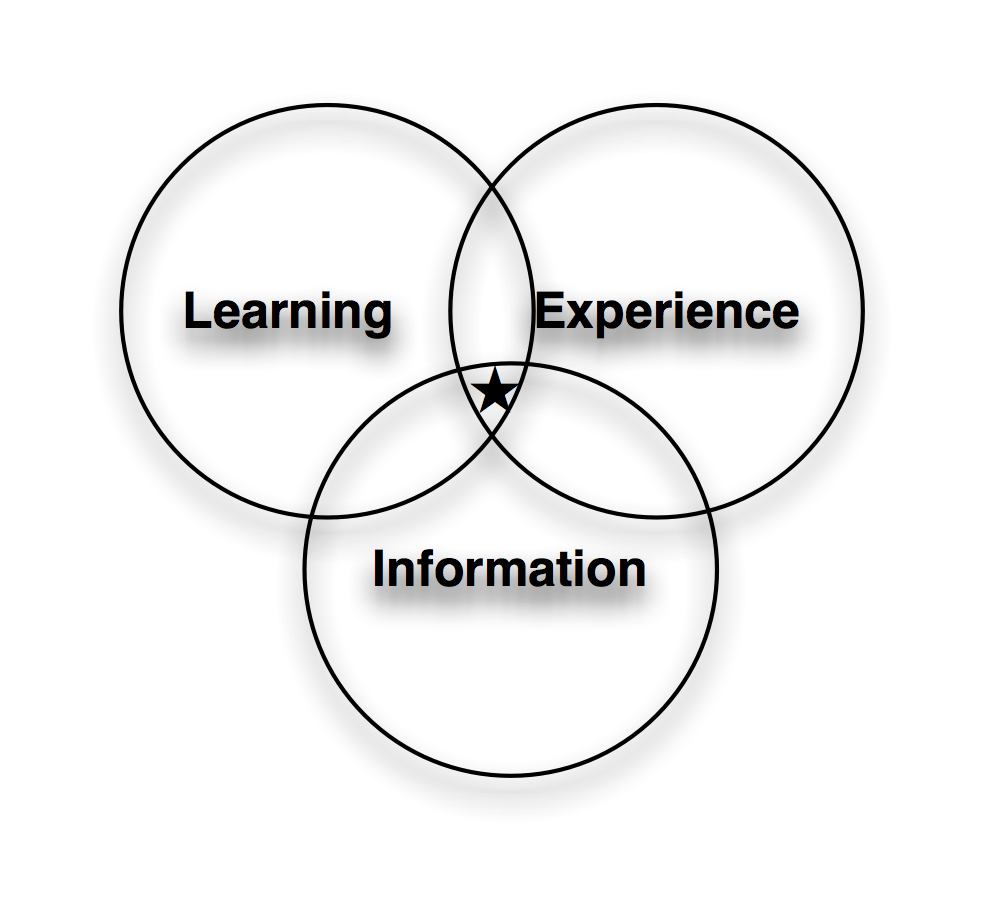
Learning/Information/Experience DesignHowever, the community of practice will be responsible for collaboratively developing the content and resources, and the training department will have morphed into learning facilitators: refining the learning, information, and experience design around the community-established content, and also facilitating the learning skills of the community and it’s members.   The learning facilitators will be monitoring the ongoing dialog and discussions, on the lookout for opportunities to help capture some outcomes, and watching the learners to look for opportunities to develop their abilities to contribute.   They’ll also be looking for opportunities to introduce new tools that can augment the community capabilities, and create new learning, communication, and collaboration channels.

Their metrics will be different, not courses or smile sheets, but value added to the community and it’s individuals, and impact on the ability of the community to be effective.   The skill sets will be different too: understanding not just instructional but information and experience design, continually experimenting with tools to look for new augmentation possibilities, and having a good ability to identify and facilitate the process of knowledge or concept work, not just the product.

10 years from now the tools will have changed, so it may be that some of the tasks can be automated, e.g. mining the nuggets from the informal channels, but design & facilitation will still be key.   We’ll distribute the roles to the tools, leaving the important pattern matching to the facilitators.

At least, that’s what I hope.

Monday Broken ID Series: Perfect Practice

1 March 2009 by Clark 1 Comment

Previous Series Post | Next Series Post
This is one in a series of thoughts on some broken areas of ID that I‘m posting for Mondays.   I intend to provide insight into many ways much of instructional design fails, and some pointers to avoid the problems. The point is not to say ‘bad designer‘, but instead to point out how to do good design.

Really, the key to learning is the practice. Learners have to apply knowledge, in the form of skills, to really internalize and ‘own‘ the learning.   Knowledge recitation, in the absence of application, leads to what cognitive science calls ‘inert knowledge‘, that‘s able to be recited back, but isn‘t activated in appropriate contexts.

What we see, unfortunately, is too much of knowledge test, and not meaningful application. We see meaningless questions seeing if people can recite back memorized facts, and no application of those facts to solve problems.   We see alternatives to the right answer that are so obviously wrong that we can pass the test without learning anything!   And we see feedback that‘s not specific to the deficit.   In short, we waste our and the learner‘s time.
What we want is appropriate challenge, contextualized performance, meaningful tasks, appropriate feedback, and more.

First, we should have picked meaningful objectives that indicate what they can do, in what context, to what level, and now we design the practice to determine whether they can do it. Of course, we may need to have some intermediate tasks to develop their skills at an appropriate pace, providing scaffolding to simplify the task until it‘s mastered.

We can scaffold in a variety of ways. We can provide tasks with simplified data first, that don‘t get complicated with other factors.   We can provide problems with parts worked, so learners can accomplish the component skills separately and then combine. We can provide support tools such as checklists or flowcharts to assist, and gradually remove them until the learner is capable.

We do need to balance the level of challenge, so that the task gets difficult at the right rate for the learner: too easy, and the learner is bored; too hard and the learner is frustrated.   Don‘t make it too easy!   If it matters, ensure they know it (and if it doesn‘t, why are you bothering?).

The trick is not only the inherent nature of the task, but many times is a factor of the alternatives to the right answer.   Learners don‘t make random mistakes (generally), they make patterned mistakes that represent inappropriate models that they perceive as appropriate.   We should choose alternatives to the right answer or choice that represent these misconceptions.

Consequently, we need to provide specific feedback for that particular misconception.   That‘s why any quiz tool that only has one response for all the wrong answers should be tossed out; it‘s worthless.

We need to ensure that the setting for the task is of interest to the learner.   The contexts we choose should setup problems that the learner viscerally understands are important problems, and ones that they are interested in.
We also need, as mentioned with examples, that the contexts seen across both examples and practice determine the space of transfer, so that still needs to be kept in mind.

The elements listed here are the elements that make effective practice, but also those that make engaging experiences (hence, the book).   That is, games.   While the best practice is individually mentored real performance, that doesn‘t scale well, and the consequences can be costly.   The next best practice, I argue, is simulated performance, tuned into a game (not turned, tuned).   While model-driven simulations are ideal for a variety of reasons (essentially infinite replay, novelty, adaptive challenge), it can be simplified to branching or linear scenarios.   If nothing else, just write better multiple choice questions!

Note that, here, practice encompasses formative and summative assessment. In either case, the learner‘s performing, it‘s just whether you evaluate and record that performance to determine what the learner is capable of.   I reckon assessment should always be formative, helping the learner understand what they know. And summative assessment, in my mind, has to be tied back to the learning objectives , seeing if they can now do what they need to be able to do that‘s difference.

If you make meaningful challenging, contextualized performance, you make effective practice.   And that‘s key to behavior change, and learning.   So practice making perfect practice, because practice makes perfect.

Designing Learning

28 February 2009 by Clark 2 Comments

Another way to think about what I was talking about yesterday in revisiting the training department is taking a broader view.   I was thinking about it as Learning Design, a view that incorporates instructional design, information design and experience design.

leiI‘m leery of the term instructional design, as that label has been tarnished with too many cookie cutter examples and rote approaches to make me feel comfortable (see my Broken ID series).   However, real instructional design theory (particularly when it‘s cognitive-, social-, and constructivist-aware) is great stuff (e.g. Merrill, Reigeluth, Keller, et al); it‘s just that most of it‘s been neutered in interpretation.   The point being, really understanding how people learn is critical.   And that includes Cross‘ informal learning.   We need to go beyond just the formal courses, and provide ways for people to self-help, and group-help.

However, it‘s not enough.   There‘s also understanding information design.   Now, instructional designers who really know what they‘re doing will say, yes, we take a step back and look at the larger picture, and sometimes it‘s job aids, not courses.   But I mean more, here.   I‘m talking about, when you do sites, job aids, or more, including the information architecture, information mapping, visual design, and more, to really communicate, and support the need to navigate. I see reasonable instructional design undone by bad interface design (and, of course, vice-versa).

Now, how much would you pay for that? But wait, there‘s more!   A third component   is the experience design.   That is, viewing it not from a skill-transferral perspective, but instead from the emotional view.   Is the learner engaged, motivated, challenged, and left leaving fulfilled?   I reckon that‘s largely ignored, yet myriad evidence is pointing us to the realization that the emotional connection matters.

We want to integrate the above.   Putting a different spin on it, it‘s about the intersection of the cognitive, affective, conative, and social components of facilitating organizational performance.   We want the least we can to achieve that, and we want to support working alone and together.

There‘s both a top-down and bottom-up component to this.   At the bottom, we‘re analyzing how to meet learner needs, whether it‘s fully wrapped with motivation, or just the necessary information, or providing the opportunity to work with others to answer the question.   It‘s about infusing our design approaches with a richer picture, respecting our learner‘s time, interests, and needs.

At the top, however, it‘s looking at an organizational structure that supports people and leverages technology to optimize the ability of the individuals and groups to execute against the vision and mission.   From this perspective, it‘s about learning/performance, technology, and business.

And it‘s likely not something you can, or should, do on your own.   It‘s too hard to be objective when you‘re in the middle of it, and the breadth of knowledge to be brought to bear is far-reaching.   As I said yesterday, what I reckon is needed is a major revisit of the organizational approach to learning.   With partners we‘ve been seeing it, and doing it, but we reckon there‘s more that needs to be done.   Are you ready to step up to the plate and redesign your learning?

Monday Broken ID Series: Examples

22 February 2009 by Clark 2 Comments

Previous Series Post |Next Series Post

This is one in a series of thoughts on some broken areas of ID that I‘m posting for Mondays.   I intend to provide insight into many ways much of instructional design fails, and some pointers to avoid the problems. The point is not to say ‘bad designer‘, but instead to point out how to do good design.

I see several reliable problems with examples, and they aren‘t even the deepest problems. They tend to be mixed in with the concept, instead of separate, if they exist at all.   Then, when they do exist, too often they‘re cookie-cutter examples, that don‘t delve into the necessary elements that make examples successful, let alone are intrinsically interesting, yet we know what these elements are!

Conceptually, examples are applications of the concept in a context.   That is, we have a problem in a particular setting, and we want to use the model as a guide to solving the problem. Note that the choice of examples is important. The broader the transfer space, that is, the more general the skills, the more you want examples that differ in many respects.   Learners generalize the concept from the examples, and the extent to which they‘ll generalize to all appropriate situations depends on the breadth of contexts they‘ve seen (across both examples and practice).   You need to ensure that the contexts the learner sees are as broadly disparate as possible.

Note that we should also be choosing problems and contexts that are of interest to the audience.   Going beyond just the cognitive role, we should be trying to tap into the motivational and engagement factors.   Factor that into the example design as well!

Now, we know that examples have to show the steps that were taken.   They have to have specific steps from beginning to end.   And, I add, those steps have to refer back to the concept that guides the presentation.   You can‘t just say “first you do this, then you do this”, etc, you have to say “first, using the model, you do this, and then the model says to do that”.   You need to show the steps, and the intermediate work products.   Annotating them is really important.

And that annotation is not just the steps, but also the underlying thought processes.   The problem is, experts don‘t even have access to their thought processes anymore!   Yet, their thinking really works along lines like “well, I could‘ve done A, but because of X, and thought B was a better approach, and then I could do C, but because of Y I tried D”, etc.   The point being, there‘s a lot of contextual clues that they evaluate that aren‘t even conscious, yet these clues are really important for learners. (BTW, this is one of the many reasons I recommend comics in elearning, thought bubbles are great for cognitive annotation.)

Another valuable component is showing mistakes and backtracking. This is a hard one to get your mind around, and yet it‘s powerful both cognitively and emotionally.   First, experts model the behavior perfectly, and when learners try, they make mistakes, and may turn off emotionally (“I‘m having trouble, and it looks so easy, I must not be good at this”).   In reality, experts make mistakes all the time, and learners need to know that. It keeps you from losing them altogether!

Cognitively it‘s valuable, too.   When experts show backtracking and repair, they‘re modeling the meta-skills that are part of the expertise.   Unpacking that self-monitoring helps learners internalize the ‘check your answer‘ component that‘s part of expert performance.   This takes more work on the part of the designer, like we had with the concept, but if the content is important (otherwise, why are you building a course), it‘s worth doing right.

Finally, I believe it‘s important to convey the example as a story.   Our brains are wired to comprehend stories, and a good narrative has better uptake.   Having a protagonist documenting the context and problem, and then solving it with the model to achieve meaningful outcomes, is more interesting, and consequently more memorable.   We can use a variety of media to tell stories, from prose, through audio (think mobile and podcasts) and narrated slideshow, animation, or video.   Comics are another channel.   Stories also are useful for conveying the underlying thought processes, via thought bubbles or reflective narration (“What was I thinking?…”).

So, please do good examples.   Be exemplary!

The ‘Least Assistance’ Principle

20 February 2009 by Clark 10 Comments

While I agree vehemently with most of a post by Lars Hyland, he said one thing I slightly disagree with, and I want to elaborate on it.   He was disagreeing with   “buying rapid development tools to bash out ill formed ‘e-learning’ to an audience that will not only be unimpressed but also none the wiser – or more productive”, a point I want to nuance.   I agree with not using rapid elearning to create courses for novices, but there is a role for bashing out courses for another audience, the practitioner.   And there’s something deeper here to tease out.

I want to bring up John Carroll’s minimalist instruction, and highly recommend it to you. He focused on a) meaningful tasks, b) active learning quickly, c) including error recogition & recovery, and d) making learning activities self-contained (a lot like games, actually).   In The Nurnberg Funnel, he documented how this design led to 25 cards, 1 per learning goal, that beat a 94 page traditionally designed manual hands-down in outcomes.

Another way to think about it is something Jim Spohrer mentioned to me once. Now, Jim’s been an Apple Fellow, and is leading research at IBM’s Almaden Research Center.   He really cares and likes to help people, but he’s very busy.   So he adopted a ‘least assistance’ principle, where he would ask himself what’s the least he can do to get this person going, because there was more to do and more people to help than he was able to keep up with.   And I think it is a useful way to think about supporting learning.

This sounds a lot like performance support, and that’s definitely a mind-set we need to adopt. When Harold Jarche and Jay Cross talk about the death of the training department, they’re talking about not focusing on courses, and instead taking a broader, performance perspective.   Obviously, we want to talk about portals of resources, but we also need to recognize that there are formal learning situations that don’t require the full formality.

We develop full courses to incorporate motivation, practice, all the things non-self-directed learners need.   But there are times when we need to provide new information and skills to self-directed learners.   When we’re talking to practitioners who are good at their job, know what they’re doing and why, and know that they need to know this information and how they’ll apply it, we can strip away a lot of the window dressing. We can just provide support to a SME so that their talk presents the relevant bits   in a streamlined and effective way, and let them loose.     That, to me, is the role of rapid elearning.

It’s not for novices, but it’s effective, and more efficient.   In this economic climate, we don’t have the luxury of full development of courses for every need.   Moreover, in any climate, we shouldn’t give people what they don’t need, instead we need to focus on what the ‘least assistance’ we can give them is.

In many cases, the least assistance we can give is self-help, which is why I believe social learning tools are one of the best investments that can be made.   The answer may well be ‘out there’, and rather than for learning designers to try to track it down and capture it, the learner can send out the need   and there’s a good chance an answer will come back!   There’s a lot to making such an environment work; it’s not the case that ‘if you build it, they will learn’, but it’s still going to fill a sweet spot in the performance ecosystem that may not be being hit as of now.

Don’t look for everything you can do in one situation, unless you’re flush with too much time and resources (in which case, watch out!), instead look for the least you can do that will get the job done so you can do more for everybody. It’s likely that’s more to their taste, anyway. And that’s enough from me on that!

Monday Broken ID Series: Concept Presentation

15 February 2009 by Clark 9 Comments

Previous Series Post | Next Series Post

This is one in a series of thoughts on some broken areas of ID that I‘m posting for Mondays.   The intention is to provide insight into many ways much of instructional design fails, and some pointers to avoid the problems. The point is not to say ‘bad designer‘, but instead to point out how to do better design.

At some point (typically, after the introduction) we need to present the concept.   The concept is the key to the learning, really.   While we‘ve derived our ultimate alignment from the performance objective, the concept provides the underlying framework to guide one‘s performance.   We use the framework to provide feedback to help the learner understand why their behavior was wrong, both in the learning experience and ideally past the learning experience the learner uses the model to continue to develop their performance.   Except that, too often, we don‘t provide the concept in a useful way.

What we too often see is a presentation of a rote procedure, without the underlying justification.   In business, we‘ll teach a process.   In software, we‘ll see feature/function presentations (literally going item by item through the menus!).   We‘ll see tutorials to achieve a particular goal without presenting an underlying model.   And that‘s broken.

We need models! The reason why is that people create mental models to explain the world.   People aren‘t very good at remembering rote things (our brains are really good at pattern matching, but not rote memorization).   We can fake it, but it‘s just crazy to have people memorize rote things unless it‘s something we have to absolutely know cold (medical terminology is an example, as are emergency checklists for flights).   By and large, very little of what we need to know needs to be memorized.

Instead, what people need are models.   Models are powerful, because they have explanatory and predictive power.   If you forget a step in a procedure, but know the model driving the performance, you can regenerate the missing step.   With software, for instance, if you present the model, and several examples where the way to do something is derived from the model, and then you have the learner use inferences from the model to do a couple of tasks, you might be saved from having to present the whole system.

People will build models, so if you don‘t give them one, it‘s quite likely that the one they do build will be wrong.   And bad models are very hard to extinguish, because we patch them rather than replace them.   It requires more responsibility on the designer to get the model, as, for reasons mentioned before, our SMEs may not be able to help us, but get them we must.   Realize that every procedure, software, or behavior has a model that drives the reason why it should be done in a particular way, and find it. Then we need to communicate it.

Multiple models help! To communicate a model most effectively, we should communicate it in several ways.   Models are more memorable than rote material, but we need to facilitate internalization.   Prose is certainly one tool we can and should use (carefully, it‘s way too easy to overwrite), but we should look at other ways to communicate it as well.

Multiple representations help in several ways.   First, they increase the likelihood that a learner will comprehend the model, and then have a path to comprehend the other representations.   Second, the multiple representations increase the number of paths to activate a model in a relevant context.   Finally, multiple representations increase the likelihood that one can map closely to the problem and facilitate a solution.

Multiple representations are, unfortunately, sometimes difficult to generate (more so than finding the original model).   However, we should always be able to at least generate a diagram.   This is because the model should have conceptual relationships, and these can be mapped to spatial relationships.   There‘s some creativity involved, but that‘s the fun part anyways!

Yes, doing good instructional design does take more work, but anything worth doing is worth doing well.   On a related, but important, note, unfortunately the difference between broken ID and good ID is subtle.     You may have to explain it (I have literally had to), but if you know what you‘re doing and why, you should be able to.   And having developed a powerful representation increases the power, and success of the learning, and consequently the performance.   Which is, of course, our goal. So, go forth and conceptualize!

Pacing

10 February 2009 by Clark 9 Comments

We recently finished watching a video series called Kamichu (we like anime).   It‘s a remarkably cute series about a middle school girl who finds out she‘s a god (apparently the Shinto belief system). There are some subtle digs at cultural artifacts like politicians, sweet explorations of the difficulties of romance, and funny running gags.   I recommend it, but the thoughts it prompted are what I‘m talking about here.

One of the interesting things about the show is it‘s speed.   Each episode unfolds at it‘s own leisurely pace, with soft musical backgrounds, and no laugh tracks.   Our (only recently) Disney-watching kids, now experienced with laugh tracks and frantic pacing, were enchanted.   It made me think about taking time to develop an atmosphere, the time taken to really develop a mood.   Good movies do that, though less and less.

I‘d recently been reflecting on pacing in music as well, regarding Pink Floyd. They similarly take the time to build the tension to make their musical flourishes.   As did the landmark Who‘s Next Album.   (Ok, so my musical tastes indicate my age.   Still, the pacing matters.)

Serendipitously, I also just read an intriguing post about the history of addiction.   It starts off talking about how we used to listen to music, hearing our favorite pieces only infrequently, and likely badly.   Similarly, getting together for conversations and fun was time-consuming.   The post then goes on to cover the rise, and fall, of opiates (legal for many years), and finally suggests that technology is our new addiction, and that we still haven‘t figured out what‘s now appropriate with technology or not.   It‘s long, but very interesting.

I‘ve gone off before about slow learning, and I think this is another facet.   Not only are we‘re rushing too much in our performance, our development processes, and the amount of time we devote to learning, we‘re not properly setting the stage.   I‘ve been quick myself, but some of the best speakers seem to take their time getting to the point.   I think there‘s a lot to process here, and perhaps a lot to learn.   We‘ve less patience, and I think that it‘s affecting our confidence to take time to do things properly.   If we don‘t, we risk it not working. If we do take our time, we run the risk of costing a bit more money.

In business, increasingly, I think we need to slow down and think a little, and the end result will end up being at least as fast, but also better quality.   I think that‘s the wise decision, what do you think?

« Previous Page
Next Page »

Clark Quinn

The Company

Search

Feedblitz (email) signup

Never miss a post
Your email address:*
Please wait...
Please enter all required fields Click to hide
Correct invalid entries Click to hide

Pages

  • About Learnlets and Quinnovation

The Serious eLearning Manifesto

Manifesto badge

Categories

  • design
  • games
  • meta-learning
  • mindmap
  • mobile
  • social
  • strategy
  • technology
  • Uncategorized
  • virtual worlds

License

Previous Posts

  • September 2026
  • August 2026
  • July 2026
  • June 2026
  • May 2026
  • April 2026
  • March 2026
  • February 2026
  • January 2026
  • December 2025
  • November 2025
  • October 2025
  • September 2025
  • August 2025
  • July 2025
  • June 2025
  • May 2025
  • April 2025
  • March 2025
  • February 2025
  • January 2025
  • December 2024
  • November 2024
  • October 2024
  • September 2024
  • August 2024
  • July 2024
  • June 2024
  • May 2024
  • April 2024
  • March 2024
  • February 2024
  • January 2024
  • December 2023
  • November 2023
  • October 2023
  • September 2023
  • August 2023
  • July 2023
  • June 2023
  • May 2023
  • April 2023
  • March 2023
  • February 2023
  • January 2023
  • December 2022
  • November 2022
  • October 2022
  • September 2022
  • August 2022
  • July 2022
  • June 2022
  • May 2022
  • April 2022
  • March 2022
  • February 2022
  • January 2022
  • December 2021
  • November 2021
  • October 2021
  • September 2021
  • August 2021
  • July 2021
  • June 2021
  • May 2021
  • April 2021
  • March 2021
  • February 2021
  • January 2021
  • December 2020
  • November 2020
  • October 2020
  • September 2020
  • August 2020
  • July 2020
  • June 2020
  • May 2020
  • April 2020
  • March 2020
  • February 2020
  • January 2020
  • December 2019
  • November 2019
  • October 2019
  • September 2019
  • August 2019
  • July 2019
  • June 2019
  • May 2019
  • April 2019
  • March 2019
  • February 2019
  • January 2019
  • December 2018
  • November 2018
  • October 2018
  • September 2018
  • August 2018
  • July 2018
  • June 2018
  • May 2018
  • April 2018
  • March 2018
  • February 2018
  • January 2018
  • December 2017
  • November 2017
  • October 2017
  • September 2017
  • August 2017
  • July 2017
  • June 2017
  • May 2017
  • April 2017
  • March 2017
  • February 2017
  • January 2017
  • December 2016
  • November 2016
  • October 2016
  • September 2016
  • August 2016
  • July 2016
  • June 2016
  • May 2016
  • April 2016
  • March 2016
  • February 2016
  • January 2016
  • December 2015
  • November 2015
  • October 2015
  • September 2015
  • August 2015
  • July 2015
  • June 2015
  • May 2015
  • April 2015
  • March 2015
  • February 2015
  • January 2015
  • December 2014
  • November 2014
  • October 2014
  • September 2014
  • August 2014
  • July 2014
  • June 2014
  • May 2014
  • April 2014
  • March 2014
  • February 2014
  • January 2014
  • December 2013
  • November 2013
  • October 2013
  • September 2013
  • August 2013
  • July 2013
  • June 2013
  • May 2013
  • April 2013
  • March 2013
  • February 2013
  • January 2013
  • December 2012
  • November 2012
  • October 2012
  • September 2012
  • August 2012
  • July 2012
  • June 2012
  • May 2012
  • April 2012
  • March 2012
  • February 2012
  • January 2012
  • December 2011
  • November 2011
  • October 2011
  • September 2011
  • August 2011
  • July 2011
  • June 2011
  • May 2011
  • April 2011
  • March 2011
  • February 2011
  • January 2011
  • December 2010
  • November 2010
  • October 2010
  • September 2010
  • August 2010
  • July 2010
  • June 2010
  • May 2010
  • April 2010
  • March 2010
  • February 2010
  • January 2010
  • December 2009
  • November 2009
  • October 2009
  • September 2009
  • August 2009
  • July 2009
  • June 2009
  • May 2009
  • April 2009
  • March 2009
  • February 2009
  • January 2009
  • December 2008
  • November 2008
  • October 2008
  • September 2008
  • August 2008
  • July 2008
  • June 2008
  • May 2008
  • April 2008
  • March 2008
  • February 2008
  • January 2008
  • December 2007
  • November 2007
  • October 2007
  • September 2007
  • August 2007
  • July 2007
  • June 2007
  • May 2007
  • April 2007
  • March 2007
  • February 2007
  • January 2007
  • December 2006
  • November 2006
  • October 2006
  • September 2006
  • August 2006
  • July 2006
  • June 2006
  • May 2006
  • April 2006
  • March 2006
  • February 2006
  • January 2006

Amazon Affiliate

Required to announce that, as an Amazon Associate, I earn from qualifying purchases. Mostly book links. Full disclosure.

We use cookies to ensure that we give you the best experience on our website. If you continue to use this site we will assume that you are happy with it.