A post I was pointed to reviews a chapter distributed thinking, a topic I like from my days getting to work with Ed Hutchins and his work on Distributed Cognition. It’s a topic I spoke about at DevLearn, and recently wrote about. The chapter is by David Perkins, one of premier thinkers on thinking, and I like several things he says.
For one, he says: “typical psychological and educational practices treat the person in a way that is much closer to person-soloâ€. I think that’s spot-on, we don’t tend to train for, and design for, the augmented human, and yet we know from situated cognition and distributed cognition that much of the problem solving we do is augmented in many ways, from pencil and paper, to calculators, references, and mobile devices.
I also like his separation of task solving from executive function, where executive function is the searching, sequencing, etc of the underlying domain-specific tasks, and how he notes that just because you create an environment that requires executive functioning, it doesn’t mean the learner will be able to develop those skills. “In general, cognitive opportunities are not in themselves cognitive scaffolds.” So treat all those so-called ‘edutainment’ games that claim to develop problem-solving skills with great care; they may require it, but there’s little effort I’ve seen that they actually develop it.
The implication is that having kids solve problems with executive support, but without scaffolding that executive support and the gradual release of those executive skills to the learner, we’re not really developing appropriate problem-solving skills. We don’t talk explicitly about them, and consequently leave the acquisition of those skills to chance. If we don’t put 21st century skills into our courses, K12, higher ed, and organizational, we’re not really developing our performers.
And that, at the end of the day, is what we need to be doing. So, start thinking a bit broader, and deeper, about learning and the components thereof, and produce better learning, learners, and ultimately the outcome performance.
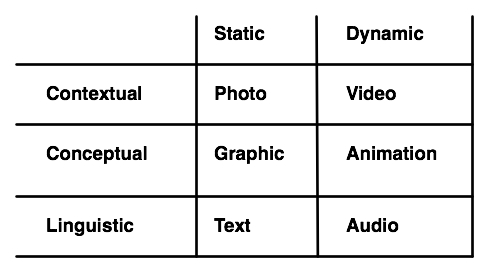 I’ve had a slight blindspot for photos and video because I peg the ‘conceptual’ meter. I recognize the value, though I don’t play with the files enough (tho’ I took a digital audio/video editing course more than a decade ago, and recently edited home videos for my wife’s birthday). Photos and videos are really good for contextualizing, and that’s particularly valuable for examples (and practice).