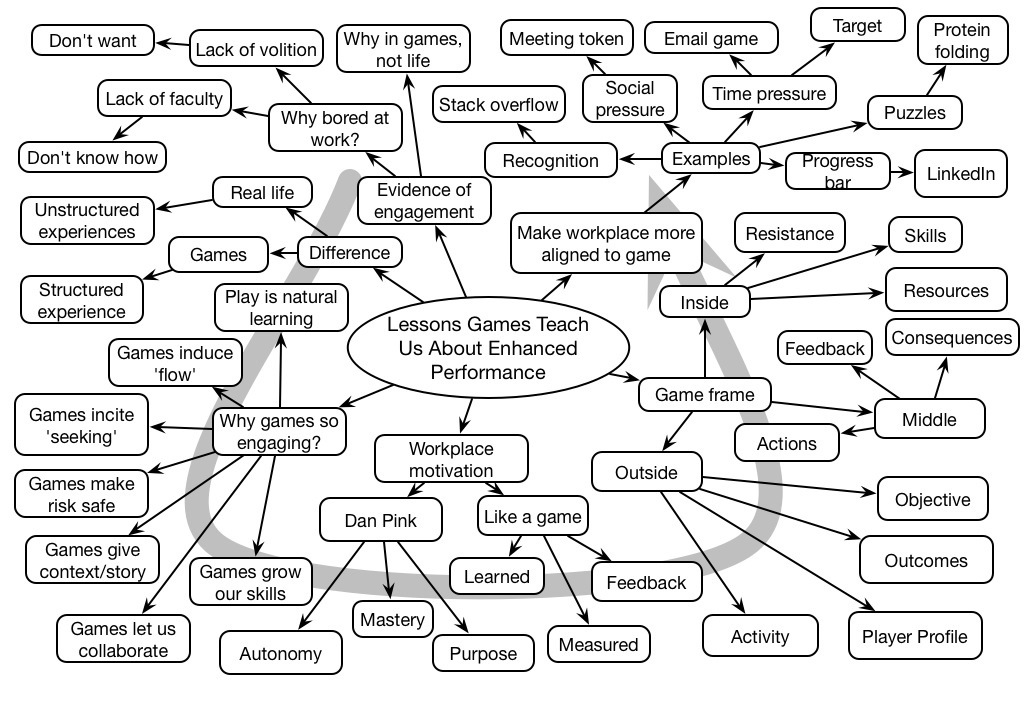
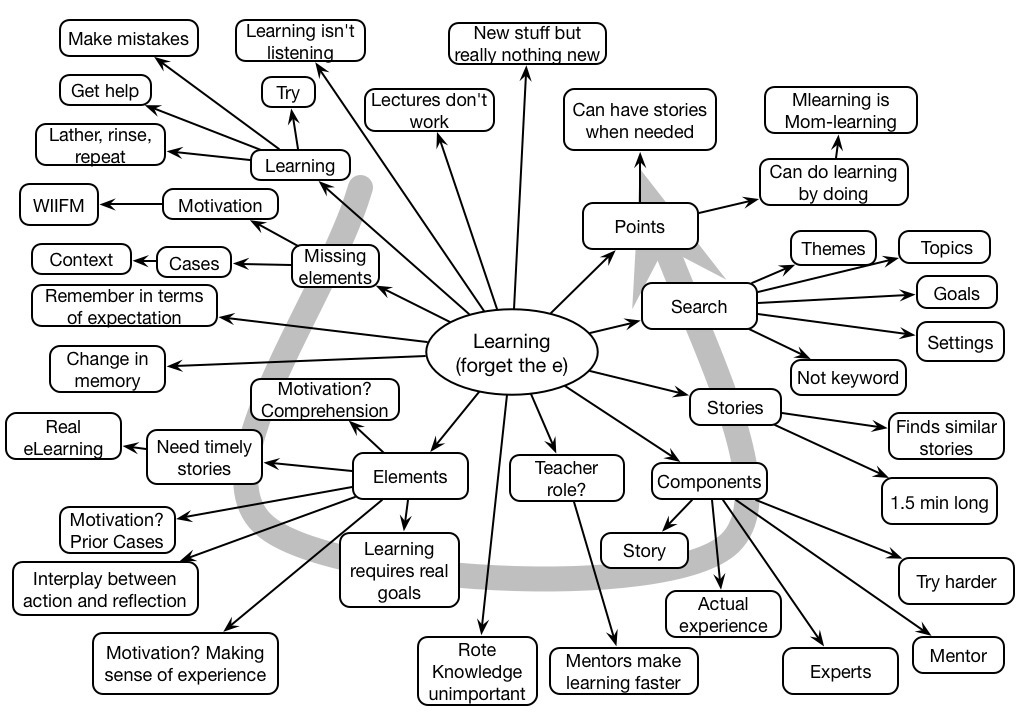
In a post last week, I mentioned how Gloria Gery’s original vision of performance support not only was supposed to help you in the moment, it was also – at least in principle – of developing you over time. And yet I have yet to see it. So what am I talking about?
Let’s use an example. I think of the typical GPS as one of the purest models of performance support: it knows where you’re trying to go (since you tell it), and it helps you every step of the way. It can even adapt if you make a mistake. It will get you there.
However, the GPS will tell you nothing about the rationale it’s using to choose your route, which can seem different than one you might have chosen on your own. Even if it offers you alternatives, or you specify preferences like ‘no toll roads’, the underlying reasoning isn’t clear. Yet this might be an opportunity for navigational learning (e.g. “this route has more lights, so we prefer the slightly longer one with fewer opportunities for stopping”).
Nor does it help you learn anything along the way: geography, political boundaries, even geology, although it could do any of these with only a thin veneer of extra work: “as we cross the river, we are also crossing the boundary between X county and Y; in 1643 the pressure between the two cities of X1 and Y1 jockeying for power led to this settlement that shared the water resource.”
It could go further, using this as an example of a greater phenomena: “geographic features often serve as political boundaries, including mountains and rivers as well as oceans”. This latter would, in a sensible approach, only be used a few times (as the message,nonce known, could become annoying. And, ideally, you could choose what you wanted to learn about.
This isn’t limited to GPS, this could be used in any instance of guided performance. Sometimes you might not care (e.g. I suspect most users of Turbo Tax don’t want to know about the nuances of the tax, they just want it done!), but if you want people to understand the reasoning as a boost to more expert performance, e.g. so they can then start using that model to infer how to deal with things that fall outside of the range of performance support, this is a missed opportunity.
The point is to have even our programs to be ‘thinking out loud‘, both to help us learn, and to serve as a check on validity. Sure, it should be able to be shut off or customized, but the processing going on provides an opportunity for learning to happen in new and meaningful ways. The more we can couple the concept to the context, the more we can create learning that will really stick. And that is, or should be, the real goal.


An increasing number of organisations, independent of size, nature or location, will acknowledge that their traditional training and development models and processes are failing to live up to the expectations of their leaders and workforce in a dynamic and global marketplace. Some will take steps to use their financial and people resources and exploit new ways of working and learning. Others will be hamstrung with outdated skills, tools and technologies, and will be too slow to adapt. A confluence of technology and improved connectivity, increasing pressures for rapid solutions and better customer service, and demands for higher performance, will force the hands of many HRDs and CLOs to refocus from models of ‘extended formal training‘ to place technology-enabled, workplace-focused and leader-led development approaches at the core of their provision. We will move a step or two closer to real-time performance support at the point of need.
We‘ll see an increasing use of mobile, and some organizations will recognize the platform that such devices provide to move the full suite of learning support (specifically performance support and informal learning) out to employees, dissolving the arbitrary boundaries between training and the full spectrum of possibilities. Others will try to cram courses onto phones, and continue to miss the bigger picture, increasing their irrelevance. Further, we‘ll see more examples of the notion of a ‘performance ecosystem‘ of resources aligned around individual needs and responsibilities, instead of organized around the providing silos. We‘ll also see more interactive and engaging examples of experience design, and yet such innovative approaches will continue to be reserved for the foresightful, while most will continue in the hidebound status quo. Finally, we‘ll see small starts in thinking semantic use in technology coupled with sound ethnographic methods to start providing just such smart support, but the efforts will continue to be embryonic.
People who know nothing about connectivism or collaborative learning will profit from MOOC‘s. Academics and instructional designers will tell anyone who wants to listen just how important formal training is, as it fades in relevance to both learners and businesses.The ITA will keep on questioning the status quo and show how work is learning and learning is the work in the network era – some will listen, many will not.
Many traditional-thinking organisations will waste a lot of time and energy trying to track social interventions in the hope that they can control and manage “social learningâ€. Whilst those organisations who appreciate that social learning is a natural and continuous part of working, will acknowledge that the most appropriate approach they can take is simply to support it in the workplace – both technologically and in terms of modelling new collaborative behaviours. Meanwhile, we will continue to see individuals and teams bypass IT and T&D departments and solve their learning and performance problems more quickly and easily using their own devices to access online resources, tools and networks.
2013 will be a great year. As William Gibson wrote, “The future‘s already here. It‘s just not evenly distributed yet.†The business world will become a bit more complex — and therefore more chaotic and unpredictable. Moore‘s Law and exponential progress will continue to work their magic and speed things up. Learning will continue to converge with work. Increasingly, workers will learn their jobs by doing their jobs. The lessons of motivation (a la Dan Pink) and the importance of treating people like people will sink in. Smart companies will adopt radical management, putting the customer in charge and reorganizing work in small teams. Senior people will recognize that emotions drive people — and there are other emotions in addition to passion. Happy workers are more engaged, more productive, and more fulfilled. What‘s not to like?