
Learnlets

Secondary

Clark Quinn’s Learnings about Learning

Search Results for: align

Y A (Yet Another) Misleading Mobile Marketing Post

23 January 2019 by Clark Leave a Comment

talking on a mobile phoneIs this YAMMMP? I suppose I can’t address  every one, but I think picking a few here and there are perhaps instructive. And, maybe, a bit fun. So there was a post on 5 mobile learning strategies. I’m a  wee bit opinionated on mobile learning, so I thought I’d have a look. And, of course, it seems to be a random selection. I guess there’s a requirement to regularly put out stuff, but it seems they get someone to make stuff up scattershot, for the sake of marketing. And while the advice isn’t  bad, it’s just random bits of advice trying to create the appearance of expertise.  Worse, it’s really not specific to mobile, and, therefore,…misleading.

  1. The first recommendation was to do ‘microlearning‘.  The worst part was their definition: short suggest of learning and  performance support.  Let’s just throw  everything  together!  Yes, small chunks of content are good. Because they match how our minds work. But this (differentiated) is not unique to mobile, it’s good advice over all! Of course, with nuances  about the formal (e.g. not just putting your course through the shredder and stream out the bits).
  2. The next recommendation was for ‘gamification’. Er, no.  Now to be fair, they do say  “gamification for serious learning”, but how do we know whether they mean immersive learning environments, or points, badges, and leaderboards? The former’s good, the latter is, I suggest, not so valuable. But again, this is undifferentiated, so it’s not obviously good advice.
  3. On to the ubiquitous ‘video’!  Yes, video can be valuable, but not generically. It can be overdone, and can intrude in a variety of ways. For instance, the audio might be inappropriate in certain contexts, and hands-free may require a visual focus that can’t be distracted. Moreover, using video appropriately again isn’t unique to mobile.
  4. And another statement that’s not unique to mobile: look to social learning. Yes, of course, social learning’s good. And, with mobile populations equipped with devices and ‘downtime’, it can be valuable.  But it’s valuable regardless of device. When it’s possible, it can add value. The obvious rises again.
  5. And, finally, personalization. Yes, great. So personalize via the small chunks from microlearning. Again, why unique to mobile?  Love the idea, but hate that it’s presented as part of a mobile strategy instead of a learning strategy.

Look, I’m a fan of mobile, obviously. But while mobile’s niche is performance support, what’s unique to mobile is context. Do something  because  of when and where you are. And this article has entirely missed it. And the other critical element  is to think of mobile as a platform. It’s not a device, it’s not an app, it’s a unique delivery channel for many possibilities. Your initial exploration can be either of the microlearning components, but recognize that as soon as you use it, you’ll be expected to do more. And thinking  platform is the key strategy here.

I understand that their intention is self-serving, these are things they can do. But pretending these are core strategies is misleading.  And that’s the problem I’d like you to learn to detect. Go to the core affordances, and then drill down. I’ve talked about my own five mobile approaches, for instance. Don’t work up from what you can do until you know what that is doing to advance your capabilities as well.  That is what’s strategic.
Redesigning Learning Design

16 January 2019 by Clark 2 Comments

Of late, a lot of my work has been designing learning design. Helping orgs transition their existing design processes to ones that will actually have an impact. That is, someone’s got a learning design process, but they want to improve it. One idea, of course, is to replace it with some validated design process. Another approach, much less disruptive, is to find opportunities to fine tune the design. The idea is to find the minimal set of changes that will yield the maximal benefit. So what are the likely inflection points?  Where am I finding those spots for redesigning?  It’s about good learning.

Starting at the top, one place where organizations go wrong right off the bat is the initial analysis for a course. There’s the ‘give us a course on this’, but even if there’s a decent analysis the process can go awry. Side-stepping the big issue of performance consulting (do a reality check: is this truly a case for a course), we get into working to create the objectives. It’s about how you work with SMEs. Understanding what they can,  and can’t, do well means you have the opportunity to ensure that you get the right objectives to design to.

From there, the most meaningful and valuable step is to focus on the practice. What are you having learners  do, and how can you change that?  Helping your designers switch to good  assessment writing is going to be useful. It’s nuanced, so the questions don’t  seem that different from typical ones, but they’re much more focused for success.

Of course, to support good application of the content to develop abilities, you need the right content!  Again, getting designers to understand what the nuances of useful examples from just stories isn’t hard but rarely done. Similarly knowing why you want  models and not just presentations about the concept isn’t fully realized.

Of course, making it an emotionally compelling experience has learning impact as well. Yet too often we see the elements just juxtaposed instead of integrated. There  are systematic ways to align the engagement and the learning, but they’re not understood.

A final note is knowing when to have someone work alone, and when some collaboration will help.  It’s not a lot, but unless it happens at the right time (or happens at all) can have a valuable contribution to the quality of the outcome.

I’ve provided many resources about better learning design, from my 7 step program white paper  to  my deeper elearning series for Learnnovators.  And I’ve a white paper about redesigning as well. And, of course, if you’re interested in doing this organizationally, I’d welcome hearing from you!

One other resource will be my upcoming workshop at the Learning Solutions conference on March 25 in Orlando, where we’ll spend a day working on learning experience design, integrating engagement and learning science.  Of course, you’ll be responsible for taking the learnings back to your learning process, but you’ll have the ammunition for redesigning.  I’d welcome seeing you there!

Locus of learning: community, AI, or org?

15 January 2019 by Clark Leave a Comment

A recent article caused me to think. Always a great thing!  It led to some reflections that I want to share. The article is about a (hypothetical) learning journey, and talks about how learning objects are part of that learning process. My issue is with the locus of the curation of those objects; should it be the organization, an AI, or the community?  I think it’s worth exploring.

The first sentence that stood out for me made a strong statement. “Choice is most productive when it is scaffolded by an organizationally-curated framework.” Curation of resources for quality and relevance is a good thing, but is the organization is the best arbiter? I’ve argued that the community of practice should determine the curriculum to be a member of that community. Similarly, the resources to support progression in the community should come from the community, both within  and outside the organization.

Relatedly, the sentence before this one states “learner choice can be a dangerous thing if left unchecked”.  And this really strikes me as the wrong model.  It’s inherently saying we don’t trust our learners to be good at learning.  I don’t  expect  learners (or SMEs for that matter) to know learning. But then, we shouldn’t leave that to chance. We should be facilitating the development of learning to learn skills explicitly, having L&D model and guide it, and more.  It’s rather an  old school approach to think that the org (through the agency of L&D) needs to control the learning.

A second line that caught my eye was that the protagonist “and his colleagues  create and share additional AI-curated briefings with each other.”  Is that AI curation, or community curation? And note that there’s ‘creation’, not just sharing.  I’m thinking that the human agency is more critical than the AI curation. AI curation has gotten good, but when a community is working, the collective intelligence is better. Or, if we’re talking IA (and we should be), we should explicitly looking to couple AI and community curation.

Another line is also curious.  “However, learning leaders must balance the popularity of informal learning with the formal, centralized needs of the organization. This can be achieved using AI-curated real-time briefings.” Count me skeptical. I believe that if you address the important issues – purpose via meaningful work and autonomy to pursue, communities of practice, and learning to learn skills – you can trust informal learning more than AI or a central view of what learning can and should be.

Most of the article was quite good, even if things like “psychological safety” are being attributed to McKenzie instead of Amy Edmondson.  I like folks looking to the future, and I understand that aligning with the status quo is a good business move. It’s just that when you get disconnects such as these, it’s an opportunity to reflect.  And wondering about the locus of responsibility for learning is a valuable exercise.  Can the locus be the individual and community, not the org or AI? Of course, better yet if we get the synergy between them.  But let’s think seriously about how to empower learners and community, ok?


A foolish inconsistency

8 January 2019 by Clark Leave a Comment

Here, a foolish inconsistency is the hobgoblin of my little mind. While there are some learnings in here (for me and others), it’s really just getting stuff off my chest. Feel free to move along. This is just a lack of consistency that I suggest is unnecessary and ill-conceived.

I’ve hinted at this before, but I don’t think I’ve gone into detail. I like LinkedIn. It’s a useful augment for business networking. However, what drives me nuts is the inconsistency between the device app and the web interface.  One instance is sufficient: messaging someone you’ve just connected to.

So, on the device, if you link to someone, you immediately get a notice and a link to send them a message. And I like that, since I like to send a quick followup to everyone I link to (a trick I learned from a colleague).  On the device, it goes straight to the messaging interface. Perfect. Now, from the invitations on the app that I want to query (e.g. it’s not clear why they’ve linked) or to explain why I won’t (I generally  don’t link to orgs, for instance), I can’t do that, but that’s ok, it can wait ’til I’m on my laptop using the (richer) web app.

On the web version, when I accept a link, I’m also offered the chance to message them, but here’s the trick: it’s not a message, it’s an InMail!  And, of course, those are limited. I don’t want to use my InMails on messaging someone I’m already linked to.  (I don’t use them in general, but that’s a separate issue.).  WHY can’t they go to messages like the app?  That’d be consistent, and this is a worse default than using messages.  I get that the app would have more limited functionality in return for being an app (there’re benefits, like notifications), but why would the full web version do things that are contrary to your interests  and intentions?!?!

Good design says consistency  is a good thing, generally; certainly aligning with user expectations and best interests. It’s bad design to do something that’s unnecessarily wasteful.  There are lots of such irritations: web forms that only tell you the expected format  after you get it wrong instead of making it easy to point to the answer  or give you a clue and sites with mismatched security (overly complex for unessential data or vice-versa) are just two examples.  This one, however, continues to be in my face regularly.

This inconsistency is instead a hobgoblin of a sensible mind. Has this irritated you, or what other silly  designs bedevil you?


PSA SPF

2 January 2019 by Clark 1 Comment

We interrupt your regularly scheduled blog series for this important public service announcement:

A number of times now, I’ve discovered that there was email being sent to me that I was  not getting. Fortunately, my ISP is also a colleague, mentor, and friend and a real expert in cybersecurity, so I asked him. And he explained it to me (and then again when I’d forgotten and it happened again; sorry Sky!).  So I’ll document it here so I can point to it in further instances. And it’s about domains and SPF, so it’s a wee bit geeky (and at the edge of my capability).  Yet it’s also important for reducing spam, and I’m  all for that. So here we go.

This started with an organization where I had been conversing with individuals.  And eventually it became clear that they had sent me a form letter, as part of a bigger mailing, and assumed I had it while I was still asking about details in said form letter. Debugging this is how I found out what happened.

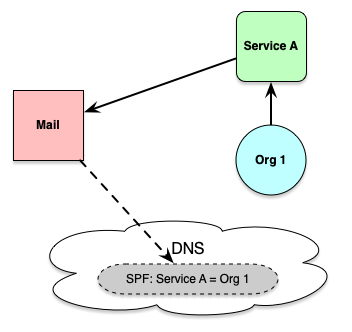
Now, when an org sends you email directly, your mail system tracks the paths it takes to get to you. If it goes back to the server for the org says the mail’s from, all’s good. For certain types of mails (e.g. event-related or service-related), however, those mails are sent via a service. A good mail server should check to see if the mail the service claims is really from the org. Otherwise, you could have a lot of people sending things pretending to be from one place but … can you say ‘spam’?  Right.

So, what the org needs to do is create a really simple one-line bit of text in something called a  Sender Policy Framework (SPF) record that says “they mail on my behalf”.  E.g. the record lets the org publish a list of IP addresses or subnets that are authorized to send email on their behalf.  And, seriously, this is simple enough that  I can do it.

Yet somehow, some orgs don’t do this. Now, some mailers don’t check, but they  should! That check to the DNS entry on behalf of the org to see if there’s an SPF covering the service will help reduce spam. So my ISP checks rigorously. And then I miss mail when people haven’t done the right thing in their tech set up. When I have this type of problem, it’s pretty much one of these.

Please, please, do check that your orgs get this right if they  do use a service. That would be orgs doing mailing lists through external providers (e.g. small firms without the resources to purchase bulk mail systems). And you can ignore this if it doesn’t apply to you, but if you do have the symptoms, feel free to point people here to help them understand what to fix. I certainly will!

We now return you to your regularly scheduled blog, already in progress.

The case for PKM

20 December 2018 by Clark 6 Comments

Seek > Sense > ShareApparently, an acquaintance challenged my colleague Harold Jarche’s Personal Knowledge Mastery (PKM)  model.  He seemed to consider the possibility that it’s a fad. Well, I do argue people should be cautious about claims. So, I’ve talked about PKM before, but I want to elaborate. Here’s my take on the case for PKM.

As context, I think meta-learning, learning to learn, is an important suite of skills to master. As things change faster, with more uncertainty and ambiguity, the ability to continually learn will be a critical differentiator. And you can’t take these skills for granted; they’re not necessarily optimal, and our education systems generally aren’t doing a good job of developing them. (Most of school practices are antithetical to self learning!)

Information is key.  To learn, you need access to it, and the chance to apply. Learning on one’s own is about recognizing a knowledge gap, looking for relevant information, applying what you find to see if it works, and once it does, to consolidate the learning.

Looking at how you deal with information – how you acquire it, how you process it, and how you share your learnings – is an opportunity to reflect. Think of it as double-loop learning, applying your learning to your own learning. We’re often no so meta-reflective, yet that ends up being a critical component to improving.

Having a framework to scaffold this reflection is a great support for improving. Then the question becomes what is the right or best support?  There are lots of people who talk about bits and pieces, but what Harold’s done is synthesize them into a coherent whole (not a ‘mashup’). PKM integrates different frameworks, and creates a practical approach.  It is simple, yet unpacks elegantly.

So what’s the evidence that it’s good?  That’s hard to test.  The acquaintance was right that just university uptake wasn’t a solid basis (I found a renowned MBA program recently that was still touting MBTI!).  The hard part would be to create a systematic test. Ideally, you’d find an organization that implements it, and documents the increase in learning. However, learning in that sense is hard to measure, because it’s personal. You might look for an increase in aggregate measures (more ideas, faster trouble-shooting), but this is personal  and is dependent on outside factors like the  culture for learning.

When you don’t have such data, you have to look for some triangulating evidence. The fact that multiple university scholars are promoting it isn’t a bad thing. To the contrary, uptake at individual institutions without a corporate marketing program is actually quite the accolade!  The fact that the workshop attendees tout it personally valuable it also a benefit. While we know that individual attendee’s reports on the outcomes of a workshop don’t highly correlate with actual impact, that’s not true for people with more expertise. And the continued reflection of value is positive.

Finally, a point I made at the end of my aforementioned previous reflection is relevant. I said: “I realize mine is done on sort of a first-principles basis from a cognitive perspective, while his is richer, being grounded in others‘ frameworks.”  Plus, he’s been improving it over the years, practicing what he preaches. My point, however, is that it’s nicely aligned with what you’d come at from a cognitive perspective. Without empirical data, theoretical justification combined with scholarly recognition and personal affirmations are a pretty good foundation.

There’re meta-lessons here as well: how to evaluate programs, and the value of meta-learning. These are worth considering. Note that Harold doesn’t need my support, and he didn’t ask me to do this. As usual, my posts are triggered by what crosses my (admittedly febrile) imagination. This just seemed worth reflecting on. So, reflections on your part?

Fun, Hard Fun, & Engagement

18 December 2018 by Clark 3 Comments

At Online Educa in Berlin, they apparently had a debate on fun in learning. The proposition was “all learning should be fun”.  And while the answer is obviously ‘no’, I think that it’s too simplistic of a question. So I want to dig a bit deeper into fun, engagement, and learning, how the right alignment is ‘hard fun’.

Donald Clark weighs in with a summary of the debate and the point he thought was the winner. He lauds Patti Shank, who pointed out that research talks about ‘desirable difficulty’. And I can’t argue with this (besides, Patti’s usually spot-on).  He goes on to cite how you read books that aren’t funny, and that how athletes train isn’t particularly giggle-inducing.  All of which I agree with, except this “Engagement and fun are proxies and the research shows that effort trumps fun every time.”  And I think tying engagement and fun together is a mistake.

There is the trivial notion of fun, to be fair.  The notion that it’s breezily entertaining.  But I want to make a distinction between such trivial attention and engagement.  For instance, I would argue that a movie like Schindler’s List is wholly engaging, but I’m not sure I would consider it ‘fun’.  And even ‘entertaining’ is a stretch. But I think it’s compelling. Similarly with even reading books for entertainment: many aren’t ‘fun’ in the sense of light entertainment and humor, but are hard to put down. So what’s going on here?

I think that cognitive (and emotional) immersion is also ‘engagement’.  That is, you find the story gripping, the action compelling, or the required performance to be a challenge, but you persist because you find it engaging in a deeper sense.

Raph Koster wrote  A Theory of Fun  about game design, but the underlying premise was that why games were ‘fun’ is that they were about learning. The continually increasing challenge, set in a world that you find compelling (we don’t all like the same games), is what makes a game fun. Similarly, I’ve written about  engagement as a far more complex notion than just a trivial view of fun.

The elements of the alignment between effective education practice and engaging experiences demonstrate that learning can, and should, be hard fun. This isn’t the trivial sort of ‘fun’ that apparently is what Donald and Patti were concerned about.  It is  all about ‘desirable difficulty’, having a challenge in the zone that’s Czikszentmihalyi’s  Flow and Vygotsky’s Zone of Proximal Development.

I agree that just making it fun (just as putting high production values on under-designed content dump) isn’t the answer. But just making it ‘work’ doesn’t help either.  You want people to see the connection between what they’re doing and their goals. Learners should have a level of challenge that helps them know that they’re working toward that goal. You want them to recognize that the tasks are for achieving that goal. It’s about integrating the cognitive elements of learning with the emotional components of engagement in a way that the whole is greater than the sum of the parts. The synergy is what is needed.

I think fun and engagement aren’t the same thing. So while I agree with the premise that learning shouldn’t be the trivial sense of fun, I think the more rigorous sense should be the goal of learning. We want learning to be a transformation, not just a trudge nor a treat.  I’ll argue that the athletes and the readers and the others who are learning  are engaged, just not amused. And that’s the important distinction. This is, to me, what Learning Experience Design should be, designing hard fun. And I think we  can  do this; my upcoming workshop at Learning Solutions is about doing just that. Hope to see you there!

Thinking Strategically

12 December 2018 by Clark Leave a Comment

Repurposed from another use.

In today‘s increasing rate of change and competition, coupled with growing ambiguity and uncertainty, L&D just can‘t be about delivering courses on demand. Optimal execution, the result of formal learning, is only the cost of entry, and continual innovation will be the necessary element for organizations to thrive. Organizations have to move faster, be more agile, and adapt more effectively.   And it‘s here that L&D has a true opportunity, and imperative, to contribute. It’s about thinking strategically.

That means, intrinsically, that L&D has to start thinking about how to move forward..   People are learning on their own more and more. The tools to access information are quite literally in the palm of their hands.   L&D can no longer be about controlling content.   Instead a new role is needed.

Rethinking Formal

How does L&D cope? The answer involves a couple of major shifts, from familiar to challenging. The first is that courses go from an event model to an approach that better reflects how we actually learn. We need to have spaced, distributed practice to truly master our skills.   This is harder than the ‘information dump and knowledge test‘ that too often characterizes organizational learning, which brings up two issues: 1) formal learning should be reserved for when it absolutely, positively has to be in the head, and 2) putting information in the world when possible.  

That latter is referring to performance support, the first step in broadening the L&D perspective. The point is that we too often use courses when cognitive skills are not the problem. Performance consulting is a process to identify the real problem and cause, and provide appropriate solutions. Performance support is often a solution we can use instead of a course!   Note that this is a first step out of the comfort zone, as it means engaging with our stakeholders, the business units we are tasked to assist. But it‘s past time!

Beyond Formal

Doing courses the right way, coupled with performance support, are the key to optimizing execution. But that‘s just the starting point.   The key to organizational improvement will be the ability to learn. And that should be L&D‘s role.   But this means we have to again step out of our comfort zone.  

We need to branch out into informal and social learning.   Employees do learn on their own, but the evidence suggests that they‘re not particularly good at it. There are lots of folk stories about what works that just aren‘t aligned with what science tells us!   Assisting the individuals and the organization to learn, independently and collectively, is the new opportunity. Assisting the organization to innovate means moving to the core of competitive advantage. And that‘s a valuable place to be.

Wishful thinking isn’t the answer. It takes both knowing the bigger picture, the performance ecosystem, and working strategically to get from here to there. That‘s what‘s on the table. It might be scary, but the opportunity offers a brighter future for L&D.   I‘m excited about the prospects, and hope you’ll be making the move.  I’d welcome the opportunity to assist, as well.

Trends for 2019?

21 November 2018 by Clark 3 Comments

It’s already started!  Like Christmas (which morally shouldn’t be even be thought about before Thanksgiving), requests for next year’s trends should be on hold until at least December.  Still, a request came in for my thoughts. Rather than send them off and await their emergence; I toss them out here, with a caveat: “It’s tough to make predictions, particularly about the future.”

1. What, on your opinion, are the main Digital Learning (DL) trends for 2019?

I think the main trend will be an increasing exploration of alternatives to ‘courses’.  This will include performance support, and social networks. Similarly, models for formal learning will shift from the ‘event’ model to a more sustained and distributed framework that segues from spaced learning through coaching.

I sincerely hope that we’ll be paying more attention to aligning learning with cognition, and pursue ‘shiny objects‘ only  after we establish a solid foundation. Instead of looking for the magic bullet, we’ll recognize that our brain architecture means we need a drip-irrigation model, not a flood.

This may be wishful thinking, but I believe we’re beginning to see some positive signs. We’re seeing more interest in  learning science, growing awareness of  myths, and more. Hopefully there’s an accompanying shift from being fascinated by technology to being interested in what technology can  do for better learning outcomes!

2. What are the main threats and obstacles, then?

The main threats and obstacles are several. For one, our own lack of understanding of the foundations of our industry hampers us. When we don’t really understand learning, we can be swayed by well-designed distractors.  That’s the second factor: there are those who are happy selling us the latest fad.

Coupled with this is a lack of business awareness in our own practices. We measure the wrong things, e.g. efficiency – such as cost/seat/hour. And we’re reluctant to talk to the stakeholders in the business. We should be worried about impact: are we reducing costs, increasing profitability or customer satisfaction?

Overall, we’re hampered by a true lack of professionalism. We learn the tools, and crank stuff out, but we’re not concerned enough about whether it’s demonstrably the  right  stuff.

3. Do you believe in the AI and DL robotization? When does this bright future come?

I believe in increasing use of AI to support functions that shouldn’t involve humans. It’s silly to have people  doing rote things we can teach computers to do. That includes responding to knowledge requests, and filtering, and a few other tasks.  However, I think we need to recognize that not all the things needed in learning, such as evaluating complex work products,  should be done by machines. I think we should look for when we can automate, and when we want people in the loop.

So I’m more interested in IA (not AI): Intelligence Augmentation.  That is, what is the  right distribution of tasks between machine and people?  There are things that computers do well, but they’re remarkably brittle; as of yet they don’t handle edge cases, or make good inferences in the grey areas very well. That’s when you want people. I think our design discipline needs to be smart about when to use each, and how they complement each other.

The future of IA is already underway, as is AI. We’re seeing, and will see more, uses of AI to filter, to answer questions, and to take over rote tasks.  These behaviors are not yet ready to be termed ‘bright’, however. Some success stories are emerging, but I suspect we don’t hear much yet about the money being wasted.  The time of consistency in effective synergies is still a few years off.

4. Your advice to the market for 2019.

Work smarter!  Get smart about learning science, about business, and about what technology can (and can’t) do. I’d like to see: staff pushing more for real impact via metrics, leaders asking for business cases not order taking, vendors pushing solutions not resource savings, and buyers asking for real evidence.  I’d like to see smarter purchasing, and the snake oil sales folks’ business withering away.  We can do better!

And I realize that my proposed trends are more wishful thinking than predictions. One of my favorite quotes is by Alan Kay: “The best way to predict the future is to invent it” so I keep pushing this agenda. My goal is simple: to make this a field I’m truly  proud to be working in. The folks in L&D, I think, are some of the nicest folks; they’re here because they  want to help others (you don’t go to L&D to become rich ;). I think there’s a promising future, but it doesn’t start with AI or ML or DL, it starts with getting down to the realities of how we learn, and how we can support it. When we do that, I think our future  will be one which will help our organizations and our people thrive. Our future  can be bright, and it’s up to us to make it so.

Transformation!

20 November 2018 by Clark 1 Comment

butterfly cocoonI’m a fan of the notion of ‘learning experience design’ (not so sure about  platforms;  I need to investigate them more ;).  The idea of integrating effective education and engaging experiences is something I’ve been  on about for a  very long time. And I want to push it a little further. I want to talk about transformation.

What am I talking about? So, I’ve previously referred to Pine & Gilmore’s concept of the Transformation Economy. That is, going beyond experiences (e.g. themed restaurants) to ones that change us. And I argue that’s what we do; we create (or should) experiences that give us new skills, new abilities to  do.  But I want to push it further.

Here I’m talking about deliberately using the idea of transformation as a learning design goal. Not just change, but leveraging the emotions as well as cognition to have the learner not just feel empowered, but transformed!  This may sound like a lofty goal, fine for a TED Talk (just read the book; recommended), but is it practical for elearning?  Well, that’s an interesting question.

Let me spin it another way: I do  not think we should be shooting for an information dump and knowledge test. For two reasons: one is that it’s not inspiring. More importantly, however, it also isn’t effective. You end up with what cognitive scientists call ‘inert knowledge’. You’ll learn it and pass a test on it, but when it’s relevant in practice it won’t even get activated!  Because you’ve never used it in ways like you practice.

I think if we are actively thinking about transformation as a goal, we might do a better job of thinking about the necessary practice and the emotional engagement.  We can focus on thinking “what will lead to the transformation we want”, and “how do we make people want it and celebrate when they’ve made the breakthrough?”  And I think this is a useful perspective.

Even for things like compliance, I’d suggest that we should be having visceral reactions like “Ok, I get it <bad behavior> is pretty heinous”, and “safety  is important, and I commit to following these rules”.  For more important things, you’d like them to feel “yes, I see, this will change how I  do this!”

Yes, it’s ambitious. But why set ourselves limited goals? When I was teaching interface design, I maintained that if I accommodated the engineers lack of background in Psych, I’d get them only so far. If I pushed them, they’d end up farther than if I was conciliatory. Similarly, here, I think we’ll do a better job if we think ‘ambitious’, and end up not as far as we’d like. I’ll suggest that’s better than satisfactorily achieving mediocrity. Most importantly, I truly think we’ll do a better job of design if we strive for transformation.

And, if there’s nothing transformative about what we’re covering, should we really be using our resources?  Let me put it another way: why  shouldn’t we do this? Seriously, I’m asking.  So, what’s your answer?


« Previous Page
Next Page »

Clark Quinn

The Company

Search

Feedblitz (email) signup

Never miss a post
Your email address:*
Please wait...
Please enter all required fields Click to hide
Correct invalid entries Click to hide

Pages

  • About Learnlets and Quinnovation

The Serious eLearning Manifesto

Manifesto badge

Categories

  • design
  • games
  • meta-learning
  • mindmap
  • mobile
  • social
  • strategy
  • technology
  • Uncategorized
  • virtual worlds

License

Previous Posts

  • March 2026
  • February 2026
  • January 2026
  • December 2025
  • November 2025
  • October 2025
  • September 2025
  • August 2025
  • July 2025
  • June 2025
  • May 2025
  • April 2025
  • March 2025
  • February 2025
  • January 2025
  • December 2024
  • November 2024
  • October 2024
  • September 2024
  • August 2024
  • July 2024
  • June 2024
  • May 2024
  • April 2024
  • March 2024
  • February 2024
  • January 2024
  • December 2023
  • November 2023
  • October 2023
  • September 2023
  • August 2023
  • July 2023
  • June 2023
  • May 2023
  • April 2023
  • March 2023
  • February 2023
  • January 2023
  • December 2022
  • November 2022
  • October 2022
  • September 2022
  • August 2022
  • July 2022
  • June 2022
  • May 2022
  • April 2022
  • March 2022
  • February 2022
  • January 2022
  • December 2021
  • November 2021
  • October 2021
  • September 2021
  • August 2021
  • July 2021
  • June 2021
  • May 2021
  • April 2021
  • March 2021
  • February 2021
  • January 2021
  • December 2020
  • November 2020
  • October 2020
  • September 2020
  • August 2020
  • July 2020
  • June 2020
  • May 2020
  • April 2020
  • March 2020
  • February 2020
  • January 2020
  • December 2019
  • November 2019
  • October 2019
  • September 2019
  • August 2019
  • July 2019
  • June 2019
  • May 2019
  • April 2019
  • March 2019
  • February 2019
  • January 2019
  • December 2018
  • November 2018
  • October 2018
  • September 2018
  • August 2018
  • July 2018
  • June 2018
  • May 2018
  • April 2018
  • March 2018
  • February 2018
  • January 2018
  • December 2017
  • November 2017
  • October 2017
  • September 2017
  • August 2017
  • July 2017
  • June 2017
  • May 2017
  • April 2017
  • March 2017
  • February 2017
  • January 2017
  • December 2016
  • November 2016
  • October 2016
  • September 2016
  • August 2016
  • July 2016
  • June 2016
  • May 2016
  • April 2016
  • March 2016
  • February 2016
  • January 2016
  • December 2015
  • November 2015
  • October 2015
  • September 2015
  • August 2015
  • July 2015
  • June 2015
  • May 2015
  • April 2015
  • March 2015
  • February 2015
  • January 2015
  • December 2014
  • November 2014
  • October 2014
  • September 2014
  • August 2014
  • July 2014
  • June 2014
  • May 2014
  • April 2014
  • March 2014
  • February 2014
  • January 2014
  • December 2013
  • November 2013
  • October 2013
  • September 2013
  • August 2013
  • July 2013
  • June 2013
  • May 2013
  • April 2013
  • March 2013
  • February 2013
  • January 2013
  • December 2012
  • November 2012
  • October 2012
  • September 2012
  • August 2012
  • July 2012
  • June 2012
  • May 2012
  • April 2012
  • March 2012
  • February 2012
  • January 2012
  • December 2011
  • November 2011
  • October 2011
  • September 2011
  • August 2011
  • July 2011
  • June 2011
  • May 2011
  • April 2011
  • March 2011
  • February 2011
  • January 2011
  • December 2010
  • November 2010
  • October 2010
  • September 2010
  • August 2010
  • July 2010
  • June 2010
  • May 2010
  • April 2010
  • March 2010
  • February 2010
  • January 2010
  • December 2009
  • November 2009
  • October 2009
  • September 2009
  • August 2009
  • July 2009
  • June 2009
  • May 2009
  • April 2009
  • March 2009
  • February 2009
  • January 2009
  • December 2008
  • November 2008
  • October 2008
  • September 2008
  • August 2008
  • July 2008
  • June 2008
  • May 2008
  • April 2008
  • March 2008
  • February 2008
  • January 2008
  • December 2007
  • November 2007
  • October 2007
  • September 2007
  • August 2007
  • July 2007
  • June 2007
  • May 2007
  • April 2007
  • March 2007
  • February 2007
  • January 2007
  • December 2006
  • November 2006
  • October 2006
  • September 2006
  • August 2006
  • July 2006
  • June 2006
  • May 2006
  • April 2006
  • March 2006
  • February 2006
  • January 2006

Amazon Affiliate

Required to announce that, as an Amazon Associate, I earn from qualifying purchases. Mostly book links. Full disclosure.

We use cookies to ensure that we give you the best experience on our website. If you continue to use this site we will assume that you are happy with it.
