Learnlets

Secondary

Clark Quinn’s Learnings about Learning

Search Results for: align

Conceptualizing the Performance Ecosystem

9 April 2009 by Clark 3 Comments

elearningvaluenet.jpgSo I’ve been playing with rethinking my Performance Ecosystem conceptualization and visualization.   The original had very discrete components, and an almost linear path, and that doesn’t quite convey the reality of how things are tied together. I believe it’s useful to help people see the components, but it doesn’t capture the goal of an integrated system.

I’ve been wrestling with my diagramming application (OmniGraffle) to rethink it.   My   notion is that systems, e.g. content/knowledge management/learning management systems underpin the learnscape, and that on top exist formal learning, performance support like job aids organized into portals, and social media.   Mobile is a layer that floats on top, making contextually accessible the capabilities assembled below.   It’s not perfect, but it’s an evolving concept (perpetual beta, right/).
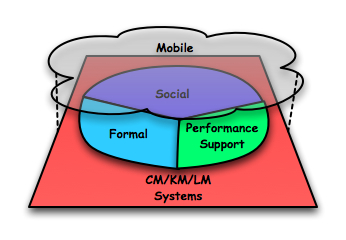
Strategic LayersSo here’s my current conception.   It took me a long time to create the circle with different components!   First I had to discover that there were tools to create freeform shapes, and then work to get them to articulate, but I like the kind of ‘rough’ feel of it (appropriate for it’s stage).

It also captures the conceptual relationships as spatial relationships (my principle for diagram creation).   At least for me.   So here’s the question: does it make sense for you?   Does it help you perceive what I’m talking about, or is it too a) coarse, b) confusing, or c) some other problem?   I welcome your feedback!
Monday Broken ID Series: Seriation

15 March 2009 by Clark 3 Comments

Previous Series Post | Last Series Post

This is one in a series of thoughts on some broken areas of ID that I’ve been posting for Mondays.   The intention is to provide insight into many ways much of instructional design fails, and some pointers to avoid the problems. The point is not to say ‘bad designer’, but instead to point out how to do better design.

Instructional design has established that the correct order of elements is introduction – concept – example – practice (and feedback) – summary.   While that’s a good default, it doesn’t have to be that way, and there are times when it makes sense to provide other approaches or even self-navigation.   What we shouldn’t see is the prevalent (click to advance ‘next’ button), with linear navigation forwards and back.   Or, rather, we shouldn’t see that without some other support.   And more.

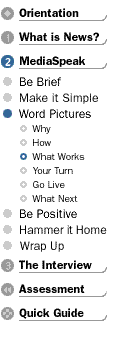
mediaskillsnavWhen we did a course on speaking to the media (and without an LMS to handle the navigation, so no built-in ‘next button’), we had a scheme that both provided a good default, and allowed self-navigation.   We had the elements of each of the 3 modules labeled from a learner perspective (e.g. Show Me, Let Me). And we had a nav bar in the upper left that let you choose where to go. At the bottom of the screen (we erred for scrolling rather than one page to minimize clicks and load times, this was over 10 years ago) were also some options of where to go next, with one indicated as the recommended choice.   We graphically supported this with a dotted   line leading the learner through the content and to the default choice (follow the bouncing ball).
Was there benefit from this?   Anecdotaly, I heard (I’d returned to the US) that about half the users followed the bouncing ball, but the other half (presumably the self-capable learners) took the initiative for their own learning and used the nav bar to go where and when *they* wanted to.   I note that UNext/Cardean had a similar nav structure at one time.

Now, you may have heard of case-, problem- or project-based learning. In this case, before you present the concept, you present either an example (a case-study) or a problem.   These serve as the introduction, but are attuned to different ways of learning.

If you buy into some of the learning style models, they have cycles through different learning approaches, but recognize that different learners could prefer to start in different areas.   That was the premise that drove at least part of the strategy behind the adaptive learning system project I led from 1999-2001. We had the system   recommend a path, and alternatives, but it was based upon who they were as a learner.

It turns out that some learners could prefer an example first, that links concept to context, some prefer problems first, to get concrete about what the situation’s about, and some might prefer a more typical approach.   We didn’t have all the answers at the time, but we had a good set of rules, and were going to extract better ones as we went along.

The point is, while a good default is a reasonable choice, having some alternative paths might be worth considering, and allowing learner navigation is almost essential.     Allowing learners to test out is a good option as well.   Don’t lock your learners into a linear experience, unless you’ve really designed it as an experience, focusing on the overall flow and testing and refining until your learners tell you it is an experience.   And I do recommend that, it’s not as tough as it sounds.   However, don’t take just the easy default, learners prefer and deserve choice.   So consider some alternative pedagogies, consider the learner, and think outside the line.

elearning, strategically

12 March 2009 by Clark 3 Comments

elearningvaluenet.jpgWhile I’ve lots more to say, I put a short version of my vision of elearning strategy in Michael Allen’s 2009 e-Learning Annual.   It’s about both getting the individual elements right, and establishing the connections between the elements to achieve synergy, not irrelevance (or worse).

This doesn’t include assessments, action plans, or more (I’m planning that for my pre-conference workshop on strategy at ASTD’s International Conference & Exposition), but it does lay out some of the reasoning and history behind the approach, the elements and some of the ways they go right (and wrong), and why they need to be tied together.

The whole book has a wonderful collection of articles.   It includes authors like Jay Cross, Karl Kapp, Lance Dublin, Bob Mosher, Ruth Colvin Clark, Marc Prensky, Saul Carliner & Margaret Driscoll, just to mention the ones I’ve met.   And important topics like Appreciative Inquiry, Performance Support, ROI, implementation, the value of research for design, virtual world design, and more.   It’s a great collection, and recommended.

However, I did want to make my chapter available, and am happy to say that I’ve done so. You can download the article (PDF).   I’d welcome your thoughts and feedback.

Workplace Learning in 10 years?

2 March 2009 by Clark 3 Comments

This month’s Learning Circuit’s blog Big Question is “What will workplace learning look like in 10 years”.   Triggered by Jay & Harold’s post and reactions (and ignoring my two related posts on Revisiting and Learning Design), it’s asking what the training department might look like in 10 years.   I certainly   have my desired answer.

Ideally, in 10 years the ‘training department’ will be an ‘organizational learning’ group, that’s looking across expertise levels and learning needs, and responsible for equipping people not only to come up to speed, but to work optimally, and collaborate to innovate.   That is, will be responsible for the full performance ecosystem.

So, there may still be ‘courses’, though they’ll be more interactive, more distributed across time, space, and context.   There’ll be flexible customized learning paths, that will not only skill you, but introduce you into the community of practice.

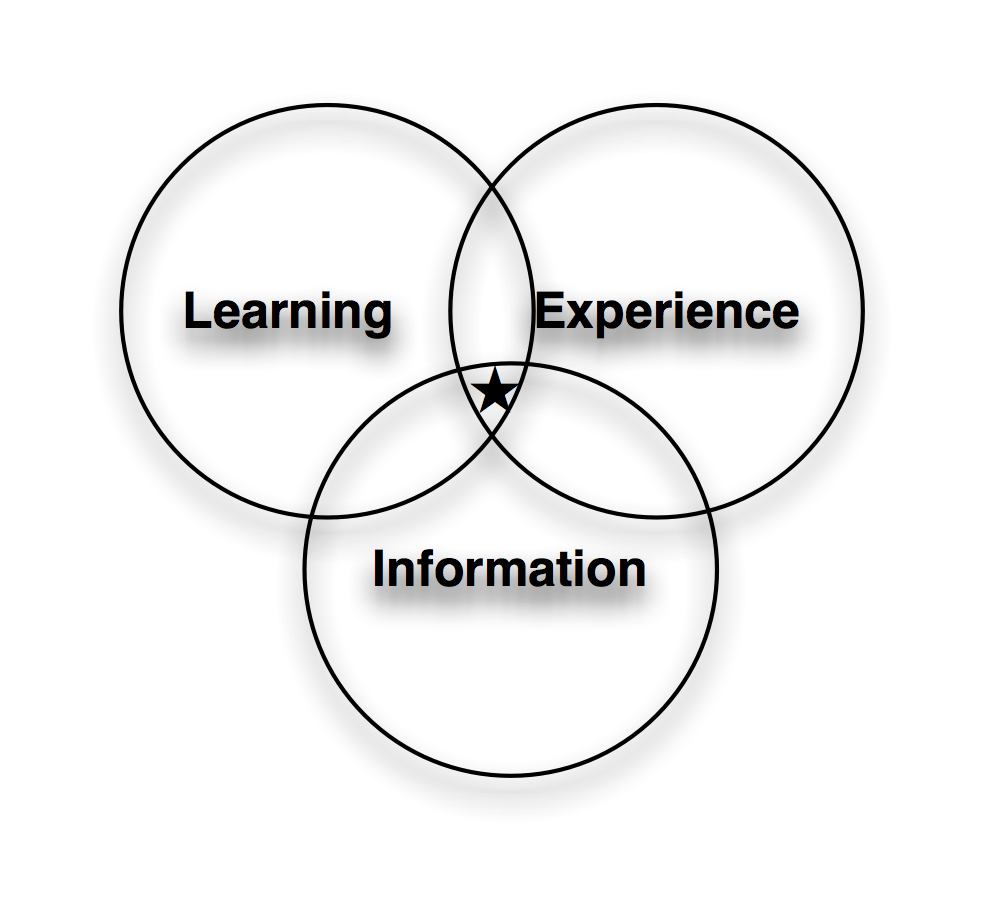
Learning/Information/Experience DesignHowever, the community of practice will be responsible for collaboratively developing the content and resources, and the training department will have morphed into learning facilitators: refining the learning, information, and experience design around the community-established content, and also facilitating the learning skills of the community and it’s members.   The learning facilitators will be monitoring the ongoing dialog and discussions, on the lookout for opportunities to help capture some outcomes, and watching the learners to look for opportunities to develop their abilities to contribute.   They’ll also be looking for opportunities to introduce new tools that can augment the community capabilities, and create new learning, communication, and collaboration channels.

Their metrics will be different, not courses or smile sheets, but value added to the community and it’s individuals, and impact on the ability of the community to be effective.   The skill sets will be different too: understanding not just instructional but information and experience design, continually experimenting with tools to look for new augmentation possibilities, and having a good ability to identify and facilitate the process of knowledge or concept work, not just the product.

10 years from now the tools will have changed, so it may be that some of the tasks can be automated, e.g. mining the nuggets from the informal channels, but design & facilitation will still be key.   We’ll distribute the roles to the tools, leaving the important pattern matching to the facilitators.

At least, that’s what I hope.

Designing Learning

28 February 2009 by Clark 2 Comments

Another way to think about what I was talking about yesterday in revisiting the training department is taking a broader view.   I was thinking about it as Learning Design, a view that incorporates instructional design, information design and experience design.

leiI‘m leery of the term instructional design, as that label has been tarnished with too many cookie cutter examples and rote approaches to make me feel comfortable (see my Broken ID series).   However, real instructional design theory (particularly when it‘s cognitive-, social-, and constructivist-aware) is great stuff (e.g. Merrill, Reigeluth, Keller, et al); it‘s just that most of it‘s been neutered in interpretation.   The point being, really understanding how people learn is critical.   And that includes Cross‘ informal learning.   We need to go beyond just the formal courses, and provide ways for people to self-help, and group-help.

However, it‘s not enough.   There‘s also understanding information design.   Now, instructional designers who really know what they‘re doing will say, yes, we take a step back and look at the larger picture, and sometimes it‘s job aids, not courses.   But I mean more, here.   I‘m talking about, when you do sites, job aids, or more, including the information architecture, information mapping, visual design, and more, to really communicate, and support the need to navigate. I see reasonable instructional design undone by bad interface design (and, of course, vice-versa).

Now, how much would you pay for that? But wait, there‘s more!   A third component   is the experience design.   That is, viewing it not from a skill-transferral perspective, but instead from the emotional view.   Is the learner engaged, motivated, challenged, and left leaving fulfilled?   I reckon that‘s largely ignored, yet myriad evidence is pointing us to the realization that the emotional connection matters.

We want to integrate the above.   Putting a different spin on it, it‘s about the intersection of the cognitive, affective, conative, and social components of facilitating organizational performance.   We want the least we can to achieve that, and we want to support working alone and together.

There‘s both a top-down and bottom-up component to this.   At the bottom, we‘re analyzing how to meet learner needs, whether it‘s fully wrapped with motivation, or just the necessary information, or providing the opportunity to work with others to answer the question.   It‘s about infusing our design approaches with a richer picture, respecting our learner‘s time, interests, and needs.

At the top, however, it‘s looking at an organizational structure that supports people and leverages technology to optimize the ability of the individuals and groups to execute against the vision and mission.   From this perspective, it‘s about learning/performance, technology, and business.

And it‘s likely not something you can, or should, do on your own.   It‘s too hard to be objective when you‘re in the middle of it, and the breadth of knowledge to be brought to bear is far-reaching.   As I said yesterday, what I reckon is needed is a major revisit of the organizational approach to learning.   With partners we‘ve been seeing it, and doing it, but we reckon there‘s more that needs to be done.   Are you ready to step up to the plate and redesign your learning?

Strategy, strategically

21 February 2009 by Clark Leave a Comment

In addition to working on the technology plan for my school district, I’ve also been assisting a not-for-profit trying to get strategic about technology.   The struggles are instructive, but looking across these two separate instances as well as the previous organizations I’ve assisted, I’m realizing that there are some common barriers.

The obvious one is time. The old saying about alligators and draining the swamp is too true, and it’s only getting worse.   Despite an economic stimulus package for the US and other countries, and (finally) a budget in my own state, things are not likely to get better soon.   Even if companies could hire back everyone they’ve laid off, the transition time would be significant.   It’s hard to sit back and reflect when you’re tackling more work with less resources.   Yet, we must.

The second part is more problematic.   Strategic thinking isn’t easy or obvious, at least to all.   For some it’s probably in their nature, but I reckon for most it takes a breadth of experience and an ability to abstract from that experience to take a broader perspective.   Abstraction, I know from my PhD research on analogy, isn’t well done without support.   Aligning that perspective with organizational goals simultaneously adds to the task.   Doing it keeping both short- and long-term values, for several different layers of stakeholders, and you’re talking some serious cognitive overhead.

We do need to take the time to be strategic.   As I was just explaining on a call, you don’t want to be taking small steps that aren’t working together towards a longer-term goal.   If you’re investing in X, and Y, and Z, and each one doesn’t build on each other, you’re missing an opportunity. If you’ve alternatives A & B, and A seems more expedient, if you haven’t looked to the future you might miss that B is a better long term investment.   If you don’t evaluate what else is going on, and leverage those initiatives because you’re just meeting your immediate needs, you’re not making the best investment for the organization, and putting yourself at risk.   You need to find a way to address the strategic position, at least for a percentage of your time (and that percentage goes up with your level in the organization).

To cope, we use frameworks and tools to help reduce the load, and follow processes to support systematicity and thoroughness. The performance ecosystem framework is one specific to use of technology to improve organizational learning, innovation, and problem-solving, but there are others.   Sometimes we bring in outside expertise to help, as we may be too tightly bound to the context and an external perspective can be more objective.

You can totally outsource it, to a big consulting company, but I reckon that the principle of ‘least assistance‘ holds here too.     You want to bring in top thinking in a lightweight way, rather than ending up with a bunch of interns trying to tie themselves to you at the wrist and ankles.   What can you do that will provide just the amount of help you need to make progress?   I have found that a lightweight approach can work in engagements with clients, so I know it can be done.   Regardless, however of wWhether you do it yourself, with partners, or bring in outside help, don’t abandon the forest for the trees, do take the time.   You need to be strategic, so be strategic about it!

Measuring the right things

18 February 2009 by Clark 7 Comments

For sins in my past, I’ve been invited on to our school district’s technology committee.   So, yesterday evening I was there as we were reviewing and rewriting the technology plan (being new to the committee, I wasn’t there when the existing one was drafted).   Broken up into five parts, including curriculum, infrastructure, funding, I was on the professional development section, with a teacher and a library media specialist.   Bear with me, as the principles here are broader than schools.

The good news: they’d broken up goals into two categories, the teacher’s tech skills, and the integration of tech into the curriculum. And they were measuring the tech skills.

The bad news: they were measuring things like percentage of teachers who’d put up a web page (using the district’s licensed software), and the use of the district’s electronic grading system. And their professional development didn’t include support for revising lesson plans.

Houston, we have some disconnects!

So, let’s take a step back.   What matters?   What are we trying to achieve?   It’s that kids learn to use technology as a tool in achieving their goals: research, problem-solving, communication.   That means, their lessons need to naturally include technology use.   You don’t teach the tool, except as ancillary to doing things with it!

What would indicate we were achieving that goal?   An increase in the use of lesson plans that incorporate technology into non-technology topics would be the most direct indicator.   Systematically, across the grade levels.   One of the problems I’ve seen is that some teachers don’t feel comfortable with the technology, and then for a year their students don’t get that repeated exposure.   That’s a real handicap.

However, teacher’s lesson plans aren’t evaluated (!).   They range from systematic to adhoc.   The way teachers are evaluated is that they have to set two action research plans for the year, and they take steps and assess the outcomes (and are observed twice), and that constitutes their development and evaluation.   So, we determined that we could make one of those action research projects focus on incorporating technology (if, as the teacher in our group suggested, we can get the union to agree).

Then we needed to figure out how to get teachers the skills they need.   They were assessed on their computer skills once a year, and courses were available.   However, there was no link between the assessment and courses.   A teacher complained that the test was a waste of time, and then revealed that it’s 15-30 minutes once a year.   The issue wasn’t really the time, it’s that the assessment wasn’t used for the teachers.

And instead of just tech courses, I want them to be working on lesson plans, and, ideally, using the tools to do so.   So instead of courses on software, I suggested that they need to get together regularly (they already meet by grade level, so all fifth grade teachers at a school meet together once a week) and work together on new lesson plans.   Actually, I think they need to dissect some good examples, then take an existing lesson plan and work to infuse it with appropriate technology, and then move towards creating new lesson plans.   To do so, of course, they’ll need to de-emphasize something.

Naturally, I suggested that they use wikis to share the efforts across the schools in the district, but that’s probably a faint hope.   We need to drive them into using the tools, so it would be a great requirement, but the level of technology skills is woefully behind the times.   That may need to be a later step.

One of the realizations is that, on maybe a ten-year window, this problem may disappear: those who can’t or won’t use tech will retire, and the new teachers will have it by nature of the culture.   So it may be a short-term need, but it is critical.   I can’t help feeling sorry for those students who miss a year or more owing to one teacher’s inability to make a transition.

At the end, we presented our results to the group.   We’ll see what happens, but we’ve a new coordinator who seems enthusiastic and yet realistic, so we’ll see what happens.   Fingers crossed! But at least we’ve tried to show how you could go towards important goals within the constraints of the system.   What ends up in the plan remains to be seen, but it’s just a school-level model of the process I advocate at the organizational level.   Identify what the important changes are, and align the elements to achieve it (a bit like ID, really).   If you’re going to bother, do it right, no?

Monday Broken ID Series: Concept Presentation

15 February 2009 by Clark 9 Comments

Previous Series Post | Next Series Post

This is one in a series of thoughts on some broken areas of ID that I‘m posting for Mondays.   The intention is to provide insight into many ways much of instructional design fails, and some pointers to avoid the problems. The point is not to say ‘bad designer‘, but instead to point out how to do better design.

At some point (typically, after the introduction) we need to present the concept.   The concept is the key to the learning, really.   While we‘ve derived our ultimate alignment from the performance objective, the concept provides the underlying framework to guide one‘s performance.   We use the framework to provide feedback to help the learner understand why their behavior was wrong, both in the learning experience and ideally past the learning experience the learner uses the model to continue to develop their performance.   Except that, too often, we don‘t provide the concept in a useful way.

What we too often see is a presentation of a rote procedure, without the underlying justification.   In business, we‘ll teach a process.   In software, we‘ll see feature/function presentations (literally going item by item through the menus!).   We‘ll see tutorials to achieve a particular goal without presenting an underlying model.   And that‘s broken.

We need models! The reason why is that people create mental models to explain the world.   People aren‘t very good at remembering rote things (our brains are really good at pattern matching, but not rote memorization).   We can fake it, but it‘s just crazy to have people memorize rote things unless it‘s something we have to absolutely know cold (medical terminology is an example, as are emergency checklists for flights).   By and large, very little of what we need to know needs to be memorized.

Instead, what people need are models.   Models are powerful, because they have explanatory and predictive power.   If you forget a step in a procedure, but know the model driving the performance, you can regenerate the missing step.   With software, for instance, if you present the model, and several examples where the way to do something is derived from the model, and then you have the learner use inferences from the model to do a couple of tasks, you might be saved from having to present the whole system.

People will build models, so if you don‘t give them one, it‘s quite likely that the one they do build will be wrong.   And bad models are very hard to extinguish, because we patch them rather than replace them.   It requires more responsibility on the designer to get the model, as, for reasons mentioned before, our SMEs may not be able to help us, but get them we must.   Realize that every procedure, software, or behavior has a model that drives the reason why it should be done in a particular way, and find it. Then we need to communicate it.

Multiple models help! To communicate a model most effectively, we should communicate it in several ways.   Models are more memorable than rote material, but we need to facilitate internalization.   Prose is certainly one tool we can and should use (carefully, it‘s way too easy to overwrite), but we should look at other ways to communicate it as well.

Multiple representations help in several ways.   First, they increase the likelihood that a learner will comprehend the model, and then have a path to comprehend the other representations.   Second, the multiple representations increase the number of paths to activate a model in a relevant context.   Finally, multiple representations increase the likelihood that one can map closely to the problem and facilitate a solution.

Multiple representations are, unfortunately, sometimes difficult to generate (more so than finding the original model).   However, we should always be able to at least generate a diagram.   This is because the model should have conceptual relationships, and these can be mapped to spatial relationships.   There‘s some creativity involved, but that‘s the fun part anyways!

Yes, doing good instructional design does take more work, but anything worth doing is worth doing well.   On a related, but important, note, unfortunately the difference between broken ID and good ID is subtle.     You may have to explain it (I have literally had to), but if you know what you‘re doing and why, you should be able to.   And having developed a powerful representation increases the power, and success of the learning, and consequently the performance.   Which is, of course, our goal. So, go forth and conceptualize!

Monday Broken ID Series: The Introduction

8 February 2009 by Clark 3 Comments

First Series Post | Next Series Post

This is one in a series of thoughts on some broken areas of ID that I‘m posting for Mondays.   The intention is to provide insight into many ways much of instructional design fails, and some pointers to avoid the problems. The point is not to say ‘bad designer‘, but instead to point out how to do better design.

One of the first things learners see is the introduction to the content; it‘s the first place that they can be disappointed, and all too often they are.   They are given objectives that don‘t matter to them, they‘re told what they‘re going to see in dull terms, it‘s all aversive rather than interesting.   Which is a wonderful way to start a learning experience, eh?

What we want to do is bring in the emotion! Almost all of instructional design is about the cognitive part, yet the motivational part is often just as important.   And we‘ve got to go beyond simplistic views of what that means.

Even cognitive science recognizes that there‘s more to the mind that the cognitive aspect, and includes the affective and conative as well.   Affective are your learning characteristics, your learner‘s styles.   Whereas conative is the interesting bit: the intention to learn, which includes things like motivation to learn, anxiety about learning, etc.

I‘ve gone off before about learning styles, and the short answer is to a) use the right media for the message, and b) to provide help for learners.   However, addressing motivation and anxiety is a different, and important, thing.   We want to assist their motivation, which happens by helping the learner connect this experience to themselves and their goals.   And we want to reduce their anxiety to an appropriate level (people perform better under a little pressure), by helping manage their expectations.

To help with motivation, there are a couple of things to do.   We know that learners learn better when we activate relevant information up front (it helps associate the new information to existing information).   I maintain that we want to extend that, and open them up emotionally too. And, I believe that it should be done first.   I think we need to indicate the consequences of the knowledge, either negative for not having the information, or positive for having the information.   I think the consequences can be exaggerated, to increase the emotional impact, within bounds, and it can be done dramatically (see Michael Allen‘s Flight Safety video) or humorously.   I‘ve used comic strips to begin elearning sections (we don’t use comics enough)!

There are nuances here: it has to be specific to the situation, not just a non-related exaggeration.   Done well, it can incorporate the cognitive association activation as well!   But hook them emotionally, and the information will stick better.   Too often in the learning I see, there‘s not just little, but essentially no addressing why this information is important to the learner, and that‘s got to be job number 1, or we risk wasting the rest of the effort.

Then we come to objectives, and here I nod in the direction of Will Thalheimer, who‘s said this better than I: the objectives we show to the learner are not the ones we use to design!   Too often, there‘s a section in the cookie-cutter template for objectives, and we slap in the ones we‘re designing to.   Wrong, bad designer, no Twinkie ™.   We (should) use objectives [previous post] to align what we‘re doing to the real need, but the learners don‘t want to know about our metrics.   The objectives for them need to be rewritten in a WIIFM (What‘s In It For Me) framework. They should get objectives that let them know what they‘ll be able to do that they can‘t do now, that they care about!

Another thing that helps, and now we‘re onto anxiety more, is addressing expectations.   Stephanie Burns showed that of people who set out to accomplish a goal, those that succeeded were those who managed their expectations appropriately.   Similarly, when I run workshops, I find I get less concerns when I help lay out what‘s going to happen and why rather than just barging ahead.   If people don‘t know what to expect, or expect it‘ll be X (e.g. entertaining) and there‘s some Y (e.g. hard work), they get frustrated or concerned with the mismatch.   They can get upset in particular if one aspect is difficult and they feel like they‘re floundering.   Making sure that the expectations are set appropriately helps learners feel like they‘re in synch with what‘s happening, and maintains their confidence.

A role that‘s cognitive as well as motivational is that we don‘t do enough has to do with contextualizing what‘s happening.   Too often, learning is conduced in a vacuum.   Yet Charles Reigeluth‘s Elaboration Theory suggests drilling down, and I say contextualize the learning in the larger context of what‘s happening in the world. Even if we‘re learning about some minor medical procedure, we can talk about how health care is a major issue, and getting it right is one of the components to make it effective and efficient.   Or somesuch, but you can quickly connect what they‘re learning to the real world, and you should.   It‘ll help again associate relevant knowledge and increase the effectiveness of the message by connecting what‘s happening now to what‘s really important.

And, I‘ll finally add, no pre-tests, unless it‘s to let the learners test out. I‘ve talked about that before, so I‘ll merely point you to my previous screed.

So, introduce your learners appropriately to the learning, get them cognitively and emotionally ready for the learning experience, and you won‘t be throwing away all the effort to develop what follows the introduction, you‘ll be maximizing it.   And that‘s what you want, at the end, is for that learning to stick.

Jumpstarting

6 February 2009 by Clark Leave a Comment

I’m on the Board of Directors for an educational not-for-profit that has had almost 30 years of successful work with programs in classrooms, nationally and internationally.   However, 5 years ago or so when I joined, they were doing almost nothing with technology.   Since then I’ve been working systematically to get them to the stage where they’re leveraging technology not just for education, but for the organization.

It’s been a slow road. There were several false starts along the way, with two separate groups within the organization having a go, but each withered.   I wrote a vision document, laying out the opportunities, but they just weren’t getting the message; they were already successful.   Several things have helped: the economic uncertainties of funding for the past few years,   an external group that looked to partner for online delivery (which went awry, sadly), and the growing use of technology by their ever-younger employees (and their audience!).

Mainly through persistence, consistently better messaging, and a growing awareness on the part of both Board and organization, I finally managed to get the Board to push for an IT Strategy from the organization, which led to the formation of an IT Committee on the Board.   (For my sins I got to chair it.)   Since then I’ve been working with the organization to start developing a strategy, though I can only advise.

Jumpstarting may seem hardly the right phrase for a several-years long process, but actually it’s a significant shift and real progress.   They’re still having trouble getting a real strategic vision, focusing a bit too much on tactics like a killer website instead of back-end system and information architecture, but it’s within grasp now.   I likely will be going down and giving the organization’s team a more in-depth view, and the Board has asked to get an overview of the new technologies and the opportunities.   I’m even going to run a survey to see if we can move to more use of technology for the Board’s communications (the number of trees…).

Persistence pays off, even in the most hidebound environments.   Serendipity helps, but you get better at getting the message across.   And the number of examples now available makes it even easier.   Jumper cables, anyone?

« Previous Page
Next Page »

Clark Quinn

The Company

Search

Feedblitz (email) signup

Never miss a post
Your email address:*
Please wait...
Please enter all required fields Click to hide
Correct invalid entries Click to hide

Pages

  • About Learnlets and Quinnovation

The Serious eLearning Manifesto

Manifesto badge

Categories

  • design
  • games
  • meta-learning
  • mindmap
  • mobile
  • social
  • strategy
  • technology
  • Uncategorized
  • virtual worlds

License

Previous Posts

  • March 2026
  • February 2026
  • January 2026
  • December 2025
  • November 2025
  • October 2025
  • September 2025
  • August 2025
  • July 2025
  • June 2025
  • May 2025
  • April 2025
  • March 2025
  • February 2025
  • January 2025
  • December 2024
  • November 2024
  • October 2024
  • September 2024
  • August 2024
  • July 2024
  • June 2024
  • May 2024
  • April 2024
  • March 2024
  • February 2024
  • January 2024
  • December 2023
  • November 2023
  • October 2023
  • September 2023
  • August 2023
  • July 2023
  • June 2023
  • May 2023
  • April 2023
  • March 2023
  • February 2023
  • January 2023
  • December 2022
  • November 2022
  • October 2022
  • September 2022
  • August 2022
  • July 2022
  • June 2022
  • May 2022
  • April 2022
  • March 2022
  • February 2022
  • January 2022
  • December 2021
  • November 2021
  • October 2021
  • September 2021
  • August 2021
  • July 2021
  • June 2021
  • May 2021
  • April 2021
  • March 2021
  • February 2021
  • January 2021
  • December 2020
  • November 2020
  • October 2020
  • September 2020
  • August 2020
  • July 2020
  • June 2020
  • May 2020
  • April 2020
  • March 2020
  • February 2020
  • January 2020
  • December 2019
  • November 2019
  • October 2019
  • September 2019
  • August 2019
  • July 2019
  • June 2019
  • May 2019
  • April 2019
  • March 2019
  • February 2019
  • January 2019
  • December 2018
  • November 2018
  • October 2018
  • September 2018
  • August 2018
  • July 2018
  • June 2018
  • May 2018
  • April 2018
  • March 2018
  • February 2018
  • January 2018
  • December 2017
  • November 2017
  • October 2017
  • September 2017
  • August 2017
  • July 2017
  • June 2017
  • May 2017
  • April 2017
  • March 2017
  • February 2017
  • January 2017
  • December 2016
  • November 2016
  • October 2016
  • September 2016
  • August 2016
  • July 2016
  • June 2016
  • May 2016
  • April 2016
  • March 2016
  • February 2016
  • January 2016
  • December 2015
  • November 2015
  • October 2015
  • September 2015
  • August 2015
  • July 2015
  • June 2015
  • May 2015
  • April 2015
  • March 2015
  • February 2015
  • January 2015
  • December 2014
  • November 2014
  • October 2014
  • September 2014
  • August 2014
  • July 2014
  • June 2014
  • May 2014
  • April 2014
  • March 2014
  • February 2014
  • January 2014
  • December 2013
  • November 2013
  • October 2013
  • September 2013
  • August 2013
  • July 2013
  • June 2013
  • May 2013
  • April 2013
  • March 2013
  • February 2013
  • January 2013
  • December 2012
  • November 2012
  • October 2012
  • September 2012
  • August 2012
  • July 2012
  • June 2012
  • May 2012
  • April 2012
  • March 2012
  • February 2012
  • January 2012
  • December 2011
  • November 2011
  • October 2011
  • September 2011
  • August 2011
  • July 2011
  • June 2011
  • May 2011
  • April 2011
  • March 2011
  • February 2011
  • January 2011
  • December 2010
  • November 2010
  • October 2010
  • September 2010
  • August 2010
  • July 2010
  • June 2010
  • May 2010
  • April 2010
  • March 2010
  • February 2010
  • January 2010
  • December 2009
  • November 2009
  • October 2009
  • September 2009
  • August 2009
  • July 2009
  • June 2009
  • May 2009
  • April 2009
  • March 2009
  • February 2009
  • January 2009
  • December 2008
  • November 2008
  • October 2008
  • September 2008
  • August 2008
  • July 2008
  • June 2008
  • May 2008
  • April 2008
  • March 2008
  • February 2008
  • January 2008
  • December 2007
  • November 2007
  • October 2007
  • September 2007
  • August 2007
  • July 2007
  • June 2007
  • May 2007
  • April 2007
  • March 2007
  • February 2007
  • January 2007
  • December 2006
  • November 2006
  • October 2006
  • September 2006
  • August 2006
  • July 2006
  • June 2006
  • May 2006
  • April 2006
  • March 2006
  • February 2006
  • January 2006

Amazon Affiliate

Required to announce that, as an Amazon Associate, I earn from qualifying purchases. Mostly book links. Full disclosure.

We use cookies to ensure that we give you the best experience on our website. If you continue to use this site we will assume that you are happy with it.