Learnlets

Secondary

Clark Quinn’s Learnings about Learning

Search Results for: align

Levels of LXD

6 April 2021 by Clark Leave a Comment

I stumbled across the Elements of UX diagram again, and happened to wonder if it would map to LXD. Here’s my stab:

And the text, as usual.


In a justifiably well-known image (PDF), Jesse James Garrett (JJG) detailed the elements of (web) user experience. I‘ve been involved in the parallel development of UX and ID (and cross-fertilized them), so I wondered what the LXD version would be. So, of course, I took a stab at levels of LXD design.

To start with, JJG‘s diagram works from the bottom up. The five levels, in order, are:

  1. The original objectives and user needs.
  2. That leads to content requirements and/or functional specifications.  
  3. The next level is an information architecture or interface design that is structured to meet those needs.  
  4. Those semantic structures are then rendered as an information design with navigation or interface design.
  5. The top level is the visual design, what the user actually sees or experiences.

This systematic breakdown has been well recognized as a useful development framework. The development from need to semantics to implementation syntax suggests a logical development flow. As an aside, no one‘s claiming we should develop in a linear manner, and there tends to be more up and down action in actual practice. Drilling down and then working from the bottom up as well is a well-known cycle of design!  
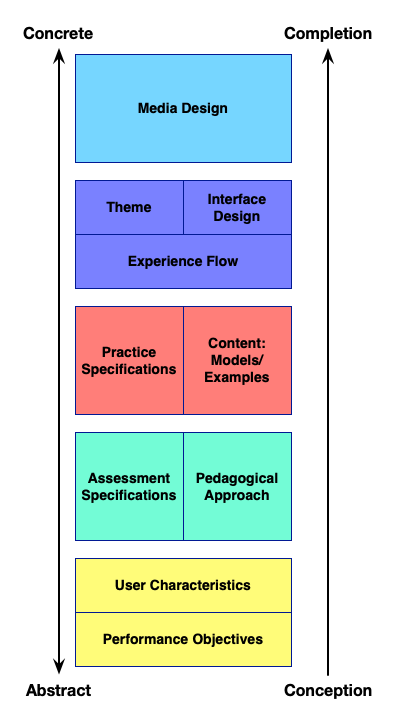
The learning equivalent, then, should similarly have a structured flow. We want to go from our needs, through various levels of representation, until we reach the learner experience.  

Given that we should be driven not by the goals for the interface but learner needs, I‘ll suggest we start with the performance objectives.   Then, in parallel with user needs, I‘ll stipulate that the other top-level definition comes from the user characteristics. These match the initial level stipulated.  

At the next level, I‘ll suggest that the performance objectives drive assessment specifications, and the other decision at this level is for the pedagogical approach. We need to know what learners need to able to do, and how we‘ll get them there.

As an intermediate representation equivalent to UX‘s information architecture or interface design, I suggest from the assessment we determine the necessary practice activities required, and these are coupled with the necessary content requirements: models and examples, as well as the introduction and closing. Here we‘re still at what‘s required, not how it manifests.  

The next level is where we start getting concrete. We need to pick an overall theme or look and feel, and the flow of the experience. We‘ll also, of course, need to make a consistent interface to support navigation and taking action. We know what we need to have, but we haven‘t actually rendered it yet.  

Finally, we must render the necessary media. This will be the videos, audios, text, diagrams, images, and more that comprise the experience. This includes the actions to be taken and the associated consequences of each choice.  

That‘s the equivalent structure I‘m suggesting are the different levels of LXD design. Of course, this is a thought exercise, and so I may well have made some interpretations you could disagree with. For instance, I may have slavishly followed JJG’s levels too closely. Let me know! Also, it‘s not clear whether this is a useful representation, so far it‘s sort of a ‘because it‘s there‘ effort ;). You can let me know your thoughts on that, too!  
Performance Support and Bad Design

30 March 2021 by Clark Leave a Comment

Here’s a story about where performance support would’ve made a task much easier.

And, as always, the text.


The other day, I had a classic need for performance support. Of course, it didn‘t exist. So here‘s a cognitive story about when and where a job aid would help.

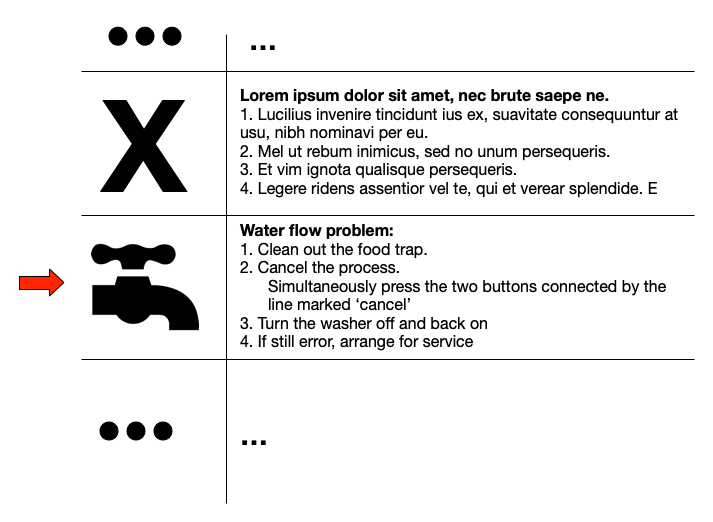
Our Bosch dishwasher stopped near the beginning of the cycle, and displayed an icon of a water tap. The goal was to get the dishwasher running again. What with the layer of undrained water, we figured there was some sort of problem with the drain, clogged or the pump broken. M‘lady had cleaned the drain, but the icon persisted. What now? Of course we could call a service person, but trying to be handy and frugal (and safe), we wanted to find out if it was something I could deal with. So, off to the manual.

Well, in this case, since I didn‘t know where the manual was, I went online. I accessed the site and downloaded the manual. Only to find no guide to what the icons mean. What?!? This violates what we know about our brains, in this case that our memory is limited. The support section of the site did list the error codes, but numerically, not by icon.  So, I had an indication I couldn’t map to a problem, let alone a  solution.  

This is a real flaw! If you‘re gonna use icons, provide a guide!  Don’t assume they’re interpretable. (This had happened once before with this same appliance, with an impenetrable icon and no clue.) As a result, I had to call the service line. That wait took awhile (with more people staying home, they‘re using their dishwashers more, and the appliances are therefore breaking down more). Once, the call dropped. The second time I had to stop because I had an upcoming call. The third time, however, I got through.

And a perfectly nice person listened, asked some questions, and then instructed me through a process. After hitting cancel (which automatically tries to drain everything and reset to zero) by simultaneously pressing two buttons linked by a line on the control panel, I heard noises in the sink like it was draining. After a minute, I was told to go ahead and open it up (yep, drained), turn it off and on, and then try running the cleaning cycle again. And, voila, it worked! (Yay!)

So, what‘s wrong with this picture? First of all, there should be a clear explanation of what the icon means, as indicated above. Second, it should be clearly tied to a process to address the problem, including intermediate steps.This is so common, I am quite boggled that the great engineers that made our (very good) dishwasher aren‘t complemented with a great technical communications team who write up a useful manual to support. It. Is. Just. Silly!

Note: this isn‘t a learning experience. It‘s just fine that I don‘t recall what the last time‘s icon was or what it meant, and maybe what this icon meant and what I should do. It should be infrequent enough that it‘d be unreasonable for me to have to recall. Instead, I should be able to look it up. Put information in the world!  In the long term, this should save them buckets of money because most people could self help. Clearly, they‘ve gone to numeric codes, but they could‘ve just added in the associated icons, or given a mapping from icon to numeric code. Something to help folks who have the pics.  

This is just bad design, and it‘s so obvious how to ameliorate it. People will self-help many times, but only if they can!   Just as you shouldn‘t be creating a training course when a job aid will do, you can save a help call when a job aid can address most of the problems. Use performance support when it makes sense, and doing so comes from understanding how we actually think, work, and learn. When you do, you can design solutions that meet real needs. And that‘s what we want to do, no?

A bad question

18 March 2021 by Clark 2 Comments

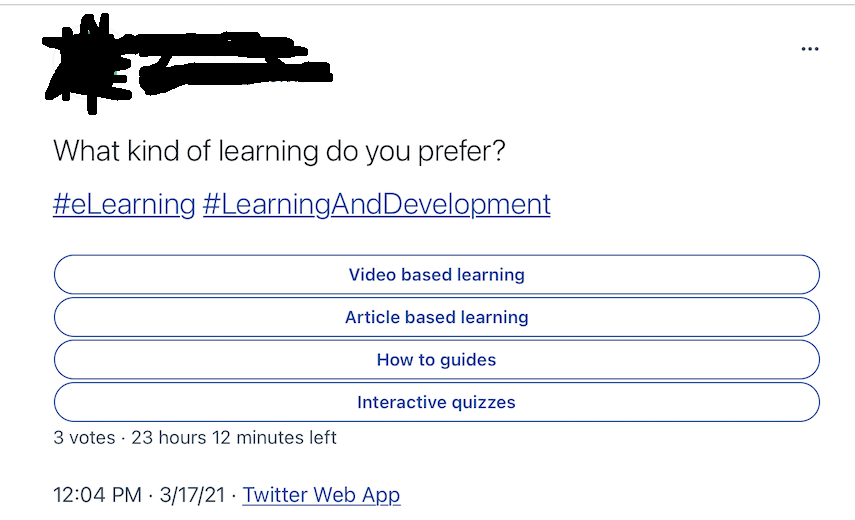
On Twitter today was a question from an organization that, frankly, puzzled me. Further, I think it’s important to understand  why this was a bad question. So here let me unpack several illustrative problems.

First, the question asks “What kind of learning do you prefer?” My initial response is: why would you ask that? What learners prefer has little to do with what outcomes you need to achieve.  We should design for the learning outcomes.

Then, there’s the list of elements:

  • Video-based learning
  • Article-based learning
  • How to guides
  • Interactive quizzes

There are several problems with this list. First, why this subset? This isn’t a full suite of alternatives. What about simulations, scenarios, or games? AR or VR? Podcasts? Why this selection?

Then, the options lack full definitions. What do they mean by ‘video-based learning’?  Is it just a video, with no assessment? Is it really ‘learning’ then? Of course, if the ‘-based’ means assessment as well, how is that separate from ‘interactive quizzes’? Similarly for articles. What is included?

Yet guides and quizzes aren’t ‘-based’. Are we assuming they’re full learning solutions? That’s questionable. A how-to guide, aka performance support, might yield an outcome, but it doesn’t guarantee learning. There are lots of factors that would influence that. And interactive quizzes, without models and examples, would be a slow way to develop expertise.

Another problem is in the separation of the elements. So, for instance, a ‘how to’ guide could be a video or an article! There’s the Youtube video I used to fix my dryer, or the step by step instructions I used to figure out how to run cables on a monitor. Likewise, interactive quizzes could include video or point to an article. These aren’t mutually exclusive categories.

The point is that this is a bad question. It’s already been taken down (I wasn’t the only one to question it!). Still, there’re lessons to be learned. (Maybe the most important is to ensure your social media marketing person has enough knowledge of learning not to do such silly things, but I can’t assume that’s the locus of the problem. It’s just a hypothesis I’ve seen play out elsewhere. ;) While there are times it makes sense to ask provocative questions, there’s also a reason to have conceptual clarity.  At least, that’s my take, I welcome yours!


How I write

16 March 2021 by Clark 1 Comment

I’d queued up this topic for a post, and then a conversation with a friend and colleague moved it to the front. We were talking about our process, and he pointed me to an article that nicely catalyzed my thinking. So here’s a brief post about how I write my books (written, of course).

The article my friend pointed me to was titled: “The Simple Way To Outline A Nonfiction Book”, and it’s nicely resonant, and a bit deeper, than my own approach. If you’re thinking about writing a book, I think this is very good advice. And the author even provides a template to get you started. And you should be thinking about writing. It does a couple of things: it forces you to think through your topic, and if it comes to fruition, it gives you some collateral. Be aware: the advice I’ve found to be true is that you make more money giving the book away. It’s a better business card!

So what the article suggests, and what aligns with what I do, is outline. That is, I outline the whole book. He suggests first doing the table of contents, generating your chapters first, then elaborating each. I do a bit more, creating a multi-level outline (often as much as up to five levels, though the innermost level often is just notes to myself what I’ll put in that section). However, this isn’t a one pass thing, it’s iterative. I’ll revisit it a time or two beforehand, and then as I write sometimes I restructure.

Which is why I need industrial strength outlining in my writing package. I want to be able to manipulate the whole document, moving sections. Which is why I use Microsoft Word, I just haven’t found that Pages can do it. Similarly, Google Docs is too awkward, and I never got my mind around Scrivener.

From there, he has a template for chapters as well. It reflects what I’ve seen in many non-fiction books, starting the chapter with a story that sets up the topic. I haven’t been able to get that formulaic, but it might be better!  I tend to write to the outline, but I’m not always telling a story to start, but I do try to set the stage with some interesting element.

Different books have emerged differently. My first,  Engaging Learning, on designing serious games, just flowed. Probably because I’d been thinking about the topic for over a decade… My second one,  Designing mLearning, was much more incremental. I’d write some, then think of something else to add up above, and then maybe a restructure of a bit, and continue, and add a bit more above, and… It was quite the effort to get to the end!  The others have varied.

My most recent effort (I’m working on a ‘Make it Meaningful’ text; how it manifests is still an open question) is an interesting case, since I’ve restructured it somewhat once already, and I think it needs a more major overhaul.  It’s partly that I’m still exploring (and people are lobbing interesting things my way). Also, it’s partly that in trying to incorporate some of my earlier stuff, I was inconsistent. It’s just that even with structure like an outline, you write in spurts, and they don’t always proceed smoothly.

Even in my more immediately forthcoming book,  Learning Science for Instructional Designers, I’d find  that I’d written about the same concept in two different places. While a text is linear, the ideas are interconnected, and can appear more than once in any path through. However, you have to choose one, and saying the same thing again is redundant.

By the way, some of that awareness comes after writing. I’ll admit that it’s an incredible ego crush to get back feedback from the editors: copy and proof. I feel stupid with all the (virtual) red ink I get! Yet, I also see how my writing changes from session to session, and having someone pull it together and point out some reliable flaws helps me improve. I completely value my editors, and am so grateful to them.

Your mileage may vary. If you don’t have a process and structure, however, you’ll struggle more than if you do. Recognize you’ll struggle, at first, and that you should allocate appropriate time. Also, each book is unique and will require its own flow, so also allocate time to discover that on subsequent efforts. Also recognize that even if you block off regular time slots to work, and set goals for those slots (and I don’t do either, by the way, I grab time when I can), you’ll still need to allocate time for revisions and even restructuring.

However, the real value is sharing your learnings. I’ve argued before that you should speak at conferences. If your ideas persist to create a coherent whole, you should consider putting them into book form. Further, if you’ve ambitions to stand out, it’s a useful way. So you should write. In your own way, of course. This is just how I write, but writing, I believe, is a good thing.


When do you team?

23 February 2021 by Clark Leave a Comment

Ideally, we’d have teams doing all our design and development. There are benefits to working together, not just for the innovation and creativity, but also for process. We can watch out for other’s mistakes and limitations just as they can look for ours. However, it can be costly to run teams when an individual will do. So, the question becomes, when do you team? And, for learning experience design I’ll suggest there are a couple of key places.

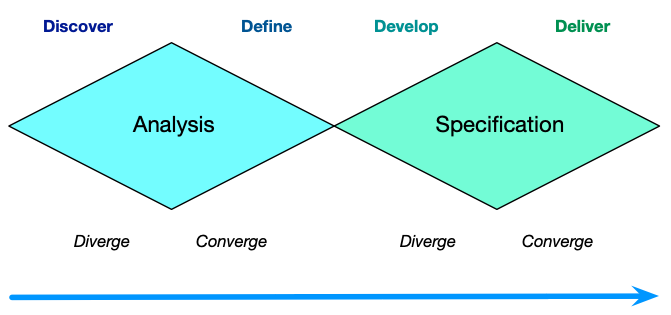
DivergeConvergeProblemSolutionNow, we want to team when we want diversity for creativity, for sure. As ‘design thinking‘ tells us, we want to diverge before we converge. Further, on both identifying the problem, and when designing a solution. The typical representation is the ‘double diamond’ that graphically represents divergence and convergence at both stages.

Who you use in each phase may differ, of course. When doing analysis, you’re likely going to want to pull in subject matter experts (SMEs) as well as potential audiences. That can include not only experts in the theory, but also those who observe the actual performers, e.g. managers or supervisors. You want to triangulate not only on the principle, but the practice, because they don’t always agree(!).

Then, you’re likely to want to pull in team members to review what’s been seen or known before you proceed.  We brainstorm, come up with some ideas, and they get taken away to be developed to the next level. Depending on the scope of your team and what you’re working on, that might be still with a smaller team, or an individual. However, if we iterate (and we should) we should converge again to check on the interim stages before moving on.

This includes for development as well. So, when you’ve got something to test, you’re going to want to bring in individuals with greater and greater representativeness to the final audience as you get closer to a final design. (BTW, there’s a lot packed into that sentence.)

We also want to minimize disruptions to our process. The goal is to find the minimal points that offer the greatest benefits to the outcome.  It’s painful to totally redo a process, and typically is unnecessary. In general, most processes try to follow a sensible process. Thus, only small tweaks can lead to large improvements in quality.

So, the answer to “when do you team” is when the benefits of the collaboration outweigh the costs of the coordination. And that’s typically where you want diversity to improve the outcome. Creating ways to ‘show your work‘ is a shortcut to some of this input, but actively generating times to coordinate into design processes ensures that you’re getting the benefits.

If not the myths person, then…?

9 February 2021 by Clark Leave a Comment

There’s a potential belief that I’m the ‘myths‘ person, and I’ve both principled and practical reasons to try to counter that. Here’s my thinking.

And, as always, the text.


I’ve a dilemma. These days, if someone posts some learning myth, people tend to let me know. And I don‘t really mind, but I do worry that it buckets me as the ‘myths‘ person. Despite the book, that‘s not really my role. Another way to bucket me would be the learning science person (my next book). That‘s better, but maybe still not quite accurate. So what the <x> person am I?

Yes, I did write a book about myths. But the purpose there was to point out bad things we‘re doing, so we can instead do better things. In fact, that‘s included: what you should do instead. It‘s really about better design, not about myths.

Similarly, the learning science book coming out is a primer on the underlying cognitive science and the implications for learning design. With the emphasis on learning design, not learning science. It concludes with two chapters on the implications and the important bits. So it‘s not about learning science per se, but as a basis for what we do with it.

Really, what I am is a learning science translator, not a myths debunker. Practically, that‘s because there‘s essentially no money in being a myths debunker. They might hire a talk, but what‘s the business model? Are you going to hire me to come in and debunk your myths? Er, that‘d be no. But there‘s a principled reason, too.  

It‘s about redesigning your learning design processes to better incorporate learning science (and avoid myths). The evidence is that the processes aren‘t well done, because we see too much bad learning. And the rationales are myriad: lack of knowledge, focus on efficiency, tool orientations, and more. Consequently, the services are similarly varied: workshops on learning science-informed design, consulting on the minimal changes to keep impacts on budget low but increase the effectiveness of the outcomes, and of course beyond: to performance consulting, informal learning, and more.

Because, L&D should properly be aligned with learning (and cognitive) science. And there are many ways to improve. That‘s what I‘m about, and that‘s why I‘m here. You can think of it as learning engineering (applied learning science), but that‘s a term still in flux in terms of meaning, since it also can mean the folks who spin the bits on complex platforms for adaptive learning, or the folks who analyze data to improve outcomes.  

I‘ve been recently calling myself a learning experience design strategist. Which is conceptually accurate, and yet unwieldy (since no one knows what it means). Yet it‘s about being strategic in learning experience design: creating processes that successfully integrate learning science with engagement to create outcomes that are effective, even transformative.

There are lots of things I do:  

  • Improve learning design processes to make learning more engaging and effective
  • Architect design approaches to address learning needs
  • Understand new technologies’ ability to enhance   learning experiences
  • Educate clients, audiences, and employees about the nuances of learning design
  • Review designs to improve effectiveness and engagement  
  • Convince clients (internal and/or external) and audiences about the value of learning science-based approaches
  • Interpret learning science and engagement research into practical guidelines

All of these are focused on being strategic about learning design. And I struggle to find another term: learning architect, learning strategist, and more. Still, there are several colleagues who are myths debunkers and learning science translators, and I‘ll suggest that you should follow, listen to, and most importantly, hire us. So, I’m not the myths person, but we do need more people applying learning science appropriately, and getting help to do so well. So whatever you want to term my role (suggestions welcome ;), do apply what we‘re talking about. Here‘s to better learning design!

Make it Meaningful: Tips ‘n’ Tricks

2 February 2021 by Clark Leave a Comment

This is the second of four posts where I’m talking about the next step beyond trivial engagement. Here I talk about some tips ‘n’ tricks that help us take our learning designs deeper in meaning.

And, as always, the text.


This is the second post about how to ‘make it meaningful‘. I talked about some tricks to maintain engagement in the previous one, and here I want to talk about what this means for the elements of learning. Here, I‘ll talk about story, challenge, exaggeration, and humor.  

First, a good experience has the characteristics of a lived story. To me, there are three major components: goal, role, and world. The goal is what the learner needs to achieve. (We choose this so that the learner won‘t achieve it unless or until they understand the necessary elements.) The role is the character that the learner is playing in trying to achieve this goal. They should be aligned. And the world is the context in which this is happening. The fantasy wrapping. Again, alignment.

The challenge to actually achieving the goal is important as well. This is what leads to learning and engagement. The alignment between Csikszentmihalyi‘s Flow and Vygotsky‘s Zone of Proximal Development lets us know that there‘re two extremes: ‘so difficult as to be frustrating‘ and ‘so easy as to be boring‘. In between is where learning, and engagement, happen. This increases as the learner‘s abilities do.

Another element to keep things from being boring is some exaggeration. That is, most of life is mundane, but our work is challenging. In the learning experience, however, what would seem challenging at work seems mundane because there is nothing really at stake.  

Thus, we can exaggerate: let‘s not work on just a patient, but the rebel leader‘s daughter, or not just a business deal, but the one that will save the company!   And, typically, we keep this down to about one level above real life, to not violate the willingness to suspend disbelief.

Finally, we can talk about humor. It‘s challenging to do, as it can be culturally specific, but appropriately applied humor can build trust and safety, and support greater exploration. And, if we realize business is a culture, we find some universals we can leverage. Timing matters, too, not just in the ‘letting a joke land‘ sense, but where and when humor‘s appropriate.  

There‘s more, but these tips ‘n’ tricks are typically missed opportunities. There‘re more details to this, of course. And, if you‘re interested in the more, I‘ll encourage you to sign up for the workshop. This is the topic of the second week!   Of course, it‘s a full workshop, so in addition to the content, we‘ll have live sessions to workshop some ideas and discuss what we‘ve done, and assignments with personal feedback.   Hope to see you there! More in my next post.


All posts in the Make It Meaningful series:

First: Hook

Second: Tips’n’Tricks

Third: Elements

Four Process

Buzzwords and Branding

26 January 2021 by Clark Leave a Comment

I was reflecting on a few things on terminology, buzzwords and branding in particular. And, as usual, learning out loud, here are my reflections.


The script:

So I’ve been known to take a bit of a blade to buzzwords (c.f. microlearning). And, I reckon there’s a distinction between vocabulary and hype. Further, I get the need for branding (and have been slack on my own part).  So, here I talk about buzzwords and branding.

First, vocabulary is important. I’m a stickler (I’m sure some would say pedantic ;) about conceptual clarity. We need to have clear language to distinguish between different concepts. (You shouldn’t say ‘cat’ when you mean ‘dog’, someone’s likely to get a wee bit confused!)

And, to be clear, there’s internal and external vocabulary. For instance, other people don’t really care about objectives, they just want outcomes. This internal vocabulary can be shortcuts, and help us minimize what we need to say to still communicate. Brevity is the soul of wit, after all.

And then there’s hype. The distinction, I reckon, is when we start tossing in buzzwords that are new, drawn from elsewhere, and promise great things. Adaptive and neuro- are two examples of buzzphrases that are open to interpretation but sound intriguing. Yet they require careful examination.

Then, there’s branding. You attach a label to something to identify it specifically. Harold Jarche’s Personal Knowledge Mastery (PKM), for instance, is a brand for a framework. So, too, would be Michael Allen’s SAM (Successive Approximation Model) and CCAF (Context-Challenge-Activity-Feedback). They’re ways to package up good ideas. And of course, t0 take ownership.

This latter step, I confess, I’ve failed on. The alignment in Engaging Learning and the different categories of mobile are two places I dropped the ball. I recently tried a brief attempt to remedy another, when I released the Performance Ecosystem Maturity Model.

I  do have the 4C’s of Mobile, but while that turns out to be useful, it’s not the most important characterization. In a conversation with someone the other day, he asked what I called the mobile framework I mentioned and he found useful. And I didn’t have an answer. I’ve talked about it before, but I didn’t label it. And yet it’s kind of the most important way to look at mobile! I use it as the organizing framework when I talk about mobile (really, the performance ecosystem):

  • Augmenting formal learning
  • Performance support (mobile’s natural niche)
  • Social (more the informal)
  • Contextual (mobile’s unique opportunity)

I wasn’t sure what to brand this, so for the moment it’s the Four Modes of mLearning (4M? 4MM?).

And for games, that alignment I mentioned I briefly termed the EEA: Effectiveness-Engagement Alignment. The point is that the elements that lead to effective education practice, and the ones that lead to engaging experiences, have a perfect alignment. It’s been a good basis for design for me. But, again, that labeling came more than a decade after the book first came out.

Ok, so I was counting on the ‘Quinnovation’ branding. And that’s worked, but it’s not quite enough to hang products on. So…I’m working on it. (And it may be that having ‘Learnlets’ separate from Quinnovation is another self-inflicted impediment!)

Still, I think it’s important to distinguish between buzzwords and branding. And they shouldn’t be the same (trademarking ‘microlearning’, anyone ;). Again, vocabulary is important, for clarity, not hype. And branding is good for attribution. But they’re not the same thing. Those are my thoughts, what are yours?

Update on my webinars

19 January 2021 by Clark Leave a Comment

I know, I know, I’ve been doing a lot of updates: books, workshops, and now webinars. I promise I’ll get back to my regular posting on learning things, but the benefit of these, unlike books or courses, is that they’re free. And several are coming up! So I thought I’d at least let you have a chance. So, here’s an update on my webinars.

First, I’ll be talking for eLearning Learning on the 27th of January at 11AM PT (2PM ET). They were interested in discussing about the impact on Covid, and of course I’m taking it in an aspirational direction. I’m presenting about how we’re not well aligned with how we think, work, and learn, and what that looks like in general, and in particular online.

Then, I’m doing a ‘make it meaningful’ presentation for iSpring on 25 Feb at 9AM PT (noon ET). The coordinates to sign up are here.   It aligns with their theme and I’ll get into some top-level issues.

Then, on 18 March, at 10AM, I’ll talk with Barbara Covarrubias Venegas on facilitating innovation. Since here topic is on virtual space, I suspect we’ll focus there. It’s a LinkedIn Live event, you can see it as one of her list of interviews.

Finally, at 10 AM PT (1PM ET) on Thursday the 13th (not Friday), I’ll be talking learning science for ATD.  That, as yet, doesn’t have a page AFAIK. More info as it emerges.

(BTW, there’s a recording of my webinar last week on learning science.)

This actually presents a pretty fair coverage of my areas of focus, so if any one (or more) is of interest, here’s a chance to see my thoughts. My general focus, as I like to quip, is on those things L&D isn’t doing, and what they’re doing badly. Which is most everything! 😁  I’m sure more webinars will eventuate, but that’s it for now. So there you go, an update on my webinars. Hope to see you there!

Update on my workshops

13 January 2021 by Clark Leave a Comment

Just as I did an update on my books, it’s time to also let you know about some workshop opportunities. Together, I think they create a coherent whole. They’re scattered around a bit, so here I lay out how they fit together, how they’re run, what they cover, and how you can find them. They’re not free, but they’re reasonably priced, with reputable organizations. So here’s an update on my workshops.

First, they’re three pieces of the picture. I talk about two things, generally. It comes from my cheeky quip that L&D isn’t doing near what it could and should, and what it  is doing, it’s doing badly. So, that first part is about the larger performance ecosystem, and the second part is about learning experience design (LXD). And, that latter part actually pulls apart into two pieces.

I see LXD as the elegant integration of learning science with engagement. Thus, you need to understand learning science (and the associated elements). Then, you  also  need to understand what makes an engaging experience. So, two workshops address each of these.

The learning science workshop is being run under the auspices of HR.com (brokered through the Allen Academy). It’s under their professional education series, called Effective Learning Strategies. It’s a five week course (with a delayed sixth week). There are readings, a weekly session, and assignments. You can earn a certificate. In it I cover the basics of cognitive science, the learning outcomes, social/cultural/emotional elements, and the implications for design. It’s just what you need to know, and very much aligned with my forthcoming book!

The second part of the story is about the engagement side. While I’ve tried to boil down learning science into the necessary core, there are other resources. This isn’t well covered. And note, I’m  not talking about tarted-up drill-and-kill, gamification, ‘click to see more’, etc. Instead, I’m going deep into building, and maintaining: motivation, reducing anxiety, and more. Formally, it’s the Make It Meaningful workshop. This is a four week course, with videos to present the information, then live sessions to practice application, and takeaway assignments from the Learning Development Accelerator. It’s based upon the learnings from my book on designing learning games,  Engaging Learning,  but I’ve spent months this past summer making it more general, going deeper, validating the newest information, and making it accessible and comprehensible.

The final story is the performance ecosystem workshop. In what may seem a silly approach, it manifests as a course on mobile! However, once you recognize that mobile is about pretty much everything but courses (and can do contextual, which is an important new direction). It makes sense. When I was writing the mobile book, the intent was that it be a stealth approach to shift the L&D mindset away from just courses. Which, of course, was made more clear with my Revolutionize L&D book. So I hope you can see that this course, too, has a solid foundation. It’s about courses, performance support, informal and social learning, contextual opportunities, and strategy, in six weeks of online sessions, with a tiny bit of reading, and interim assignments. It’s by the Allen Academy directly.

Together, I think these three workshops provide the knowledge foundations you need to run a L&D operation. Two talk about what makes courses that are optimally engaging and effective, and one looks at the rest of the picture. Evidence suggests there’s a need. And I’ve worked hard to ensure that they’ve got the right stuff. So that’s an update on my workshops. I welcome your thoughts and feedback.  (And, yes, I’d like to pull them all together in one place, but I haven’t found a platform I like yet; stay tuned!)


« Previous Page
Next Page »

Clark Quinn

The Company

Search

Feedblitz (email) signup

Never miss a post
Your email address:*
Please wait...
Please enter all required fields Click to hide
Correct invalid entries Click to hide

Pages

  • About Learnlets and Quinnovation

The Serious eLearning Manifesto

Manifesto badge

Categories

  • design
  • games
  • meta-learning
  • mindmap
  • mobile
  • social
  • strategy
  • technology
  • Uncategorized
  • virtual worlds

License

Previous Posts

  • March 2026
  • February 2026
  • January 2026
  • December 2025
  • November 2025
  • October 2025
  • September 2025
  • August 2025
  • July 2025
  • June 2025
  • May 2025
  • April 2025
  • March 2025
  • February 2025
  • January 2025
  • December 2024
  • November 2024
  • October 2024
  • September 2024
  • August 2024
  • July 2024
  • June 2024
  • May 2024
  • April 2024
  • March 2024
  • February 2024
  • January 2024
  • December 2023
  • November 2023
  • October 2023
  • September 2023
  • August 2023
  • July 2023
  • June 2023
  • May 2023
  • April 2023
  • March 2023
  • February 2023
  • January 2023
  • December 2022
  • November 2022
  • October 2022
  • September 2022
  • August 2022
  • July 2022
  • June 2022
  • May 2022
  • April 2022
  • March 2022
  • February 2022
  • January 2022
  • December 2021
  • November 2021
  • October 2021
  • September 2021
  • August 2021
  • July 2021
  • June 2021
  • May 2021
  • April 2021
  • March 2021
  • February 2021
  • January 2021
  • December 2020
  • November 2020
  • October 2020
  • September 2020
  • August 2020
  • July 2020
  • June 2020
  • May 2020
  • April 2020
  • March 2020
  • February 2020
  • January 2020
  • December 2019
  • November 2019
  • October 2019
  • September 2019
  • August 2019
  • July 2019
  • June 2019
  • May 2019
  • April 2019
  • March 2019
  • February 2019
  • January 2019
  • December 2018
  • November 2018
  • October 2018
  • September 2018
  • August 2018
  • July 2018
  • June 2018
  • May 2018
  • April 2018
  • March 2018
  • February 2018
  • January 2018
  • December 2017
  • November 2017
  • October 2017
  • September 2017
  • August 2017
  • July 2017
  • June 2017
  • May 2017
  • April 2017
  • March 2017
  • February 2017
  • January 2017
  • December 2016
  • November 2016
  • October 2016
  • September 2016
  • August 2016
  • July 2016
  • June 2016
  • May 2016
  • April 2016
  • March 2016
  • February 2016
  • January 2016
  • December 2015
  • November 2015
  • October 2015
  • September 2015
  • August 2015
  • July 2015
  • June 2015
  • May 2015
  • April 2015
  • March 2015
  • February 2015
  • January 2015
  • December 2014
  • November 2014
  • October 2014
  • September 2014
  • August 2014
  • July 2014
  • June 2014
  • May 2014
  • April 2014
  • March 2014
  • February 2014
  • January 2014
  • December 2013
  • November 2013
  • October 2013
  • September 2013
  • August 2013
  • July 2013
  • June 2013
  • May 2013
  • April 2013
  • March 2013
  • February 2013
  • January 2013
  • December 2012
  • November 2012
  • October 2012
  • September 2012
  • August 2012
  • July 2012
  • June 2012
  • May 2012
  • April 2012
  • March 2012
  • February 2012
  • January 2012
  • December 2011
  • November 2011
  • October 2011
  • September 2011
  • August 2011
  • July 2011
  • June 2011
  • May 2011
  • April 2011
  • March 2011
  • February 2011
  • January 2011
  • December 2010
  • November 2010
  • October 2010
  • September 2010
  • August 2010
  • July 2010
  • June 2010
  • May 2010
  • April 2010
  • March 2010
  • February 2010
  • January 2010
  • December 2009
  • November 2009
  • October 2009
  • September 2009
  • August 2009
  • July 2009
  • June 2009
  • May 2009
  • April 2009
  • March 2009
  • February 2009
  • January 2009
  • December 2008
  • November 2008
  • October 2008
  • September 2008
  • August 2008
  • July 2008
  • June 2008
  • May 2008
  • April 2008
  • March 2008
  • February 2008
  • January 2008
  • December 2007
  • November 2007
  • October 2007
  • September 2007
  • August 2007
  • July 2007
  • June 2007
  • May 2007
  • April 2007
  • March 2007
  • February 2007
  • January 2007
  • December 2006
  • November 2006
  • October 2006
  • September 2006
  • August 2006
  • July 2006
  • June 2006
  • May 2006
  • April 2006
  • March 2006
  • February 2006
  • January 2006

Amazon Affiliate

Required to announce that, as an Amazon Associate, I earn from qualifying purchases. Mostly book links. Full disclosure.

We use cookies to ensure that we give you the best experience on our website. If you continue to use this site we will assume that you are happy with it.