Learnlets

Secondary

Clark Quinn’s Learnings about Learning

Search Results for: engagement

The pain of learning

27 December 2018 by Clark Leave a Comment

My dad, in his last years, lost the use of his hands and most of his hearing. It seemed like he then gave up. I finally challenged him on it, and he said “when you’re in constant pain…”.  And I got it.

So, turns out I’ve a misbehaving disk in my back, and it started pressing on the nerve over the summer. Pain scales are 1-10; this ultimately got to an 8 when I was trying to walk or even stand (from my lower back down my leg to my toes). Tried physio, non-steroidal anti-inflammatories, and then a steroid pack; nope. The ‘big hammer’ option was a cortisone injection, and that happened. Better yet, it knocked it back; down to 1). Er, for some six – eight weeks, then it came back. They gave me another one sooner than they were supposed to, but it hasn’t worked (ok, it’s knocked it to a 6 on average, but…this isn’t tolerable).  And my point here isn’t that I’m looking for sympathy, but to (of course) talk about the learnings. Because, despite the physical pain, there are learnings (good and bad).

Because there’re a physiological basis (pressing on the nerve), I’ve stuck with treatments likely to minimize the inflammation. I haven’t looked at a chiropractor nor acupuncture. Given that the current approaches are failing, those may come up, though I’m expecting surgery as the nuclear option. Not that I’m eager (to the contrary!). One learning is how close minded I can be about exploring alternative solutions. On the other hand, as it shoots down the leg into my foot, I’ve learned a lot more about physiology!

In the course of navigating airports and the like while in the throws of this (long story), I  also  found that the milk of human kindness can be diluted by pain. When you’re muttering obscenities under your breath because of the knives that accompany every step, clueless actions on the part of others – like stopping suddenly, blocking access, or even just bad signage – can earn muffled imprecations and aspersions on parentage and intelligence.  I’ve always tried to maintain ‘situational awareness’ (and know I’ve failed at times), but I highly recommend it!

On the other hand, when sitting (the only time it settles down), I’m expanding on my growing recognition over the past years that I have no idea what anyone else may be going through.  I’m sure my limping through parking lots and stores can be perceived as congenital damage or wear and tear. There’s no real way for anyone to know how much someone else hurts. We don’t have meters over our heads or icons.

And I’m increasingly grateful!  That may sound odd, but this experience is teaching me (and I am trying to find the positive).  Finding ways to minimize it is an ongoing experimentation. The support of my family helps, and I’ve learned (some) to ask for help.  But even an involuntary and undesirably challenging experience still is an experience.

Also, as much as it may be hard to struggle to find time and motivation for exercise, you learn to miss it. It seems every time I start taking a serious stab at diet and exercise, something goes wrong!  It’s almost like I’m not supposed to; and I know that’s wrong.  (I’ve also learned to secretly suspect my pain doctor is a closet sadist, but that’s the pain talking. :)

This is definitely  not ‘hard fun‘, to be clear. This is much more lemonade.  Fingers crossed that this, too, will pass. And if you do see me limping around, cut me some slack ;).  But also, please understand that it’s hard to know what other people are going through, and do your best to be sympathetic. Which seems like the right message for this time of year anyway. Wishing you and yours all the best for the holidays and the new year!

From instructor to designer & facilitator

26 December 2018 by Clark Leave a Comment

Someone on Quora asked me about the instructor role:
How would the role of a teacher change in this modern online learning world?
While I posted an answer there, I thought I’d post it here too:

I see two major roles in that of the ‘teacher‘: the designer of learning experiences (pre), and the facilitator of same (during/post). I think the design changes by returning to natural learning approaches, an apprenticeship model (c.f. Cognitive Apprenticeship). Our wetware hasn‘t changed, so we want to use technology as an augment. Tech can make it easier to follow such a design paradigm.

The in-class role moves from presentation to facilitation. Ideally we have content and check, as well as any preliminary experiences, done in a ‘flipped model‘. Leveling-up learners to a baseline happens before engaging in the key learning activities. Major activities can be solo if the material is more dedicated to training, but ideally are social particularly when complex understandings are required (mostly).

The role of teacher is to check in on group discussions and projects, and bring out important lessons from the report-backs. We extend the learning with efforts to either or both of expand understandings into more contexts, or document the resulting applied understandings, to create a unified understanding.

Application-based instruction is the focus, having learners do things with the learning, not just recite it. The design role is to create a sequence of preparation, meaningful engagement, and knowledge consolidation that‘s a learning experience. The facilitation role is to help bring out misconceptions and important hints and tips to lead to learner success.

This really is true face-to-face as well, but technology offers us tools to take the drudge work out of the experience and end up having the facilitation role be focused on the most valuable aspects. That‘s my take, at any rate.

And what’s your take?

(And this may be my only post this week; happy holidays everyone!)

Editing, process, topics, and other reflections

27 November 2018 by Clark Leave a Comment

My lass let me know there was a typo in my recent post on Transformation.  I’m thrilled that she’s reading them (!), but she triggered many thoughts about my writing approach. I thought I’d share how I deal with blogging, articles, and writing in general, as a ‘show your work‘ effort. And, in a sense, solicit your thoughts on approach, editing, and topics (amongst other things).

Process

It starts with my commitment to two blog posts a week. And I’m pretty sure I average that, since while I occasionally only get one, I also occasionally get three (say, during a week at a conference with mindmaps).  That means, however, that sometimes I’m brimming with ideas and have them queued up a week or two in advance, and sometimes I’m writing them at the last minute (*cough* this one *cough*).  When I know I’ll be on the road on a particular week, I definitely try to have them in the hopper in advance.

Regardless, I tend to write each in one fell swoop. Something sparks a thought, and I rush to get it down. Sometimes I’ll have an idea elsewhere, and jot myself a one line reminder, and need to generate the full prose. But my writing’s often like that: once I’m going, I have to let that full idea gestate. Even when writing a full book (as I’ve done a time or two ;), I outline it in a go, and then write sections in a burst.

Now, I write in several channels: my blog, my committed articles, and of course books. And, not surprisingly, I write them differently.  The blog comes out ‘as is’. I do reread it after it’s first done, typically, but as my lass discovered, it can have flaws. I reread my Trends article after posting, for instance, and noticed a couple of flaws. (I’ve fixed them, of course, similarly when folks comment in one way or another about something I’ve left confusing or wrong.)

My articles are different. I write them typically in one go, but I always hang on to them for at least a day, and reread with fresh eyes. I think that’s obligatory for such efforts. In one case, I have an editor who reads them with a careful eye, and always sends back a revised version. I don’t get to  see the revisions (which is frustrating), but the articles are always improved. Editing is valuable!

For books, as I mentioned, I outline it, then write sections. And, depending on the book, the experience changes. With  Engaging Learning, it had been percolating for so long it kind of flew out of my fingers onto the page.  For  Designing mLearning, it was different; I outlined, and wrote, and as I got further in I found myself rearranging the structure and going back to add things.  The Revolutionize L&D book was closer to the Designing mLearning book, with two changes. I didn’t reorganize as much, but I kept going back and adding stuff. It was hard to finish!

With my books, I’ve always had an editor. The ones from the publisher varied in quality (good experiences generally), but I also have m’lady serve as my first (and best) editor. And I’ve learned to truly value an editor. The benefit of a second eye without the assumptions and blinders the writer brings is great!

Topics

The ideas come differently as well. My blog tends to get whatever I’m thinking about (like this). My articles tend to be a deeper dive into whatever I think (or we agree, with my editor) is important. I keep a list of potential topics for each, and take whatever feels ‘right’ for the month.

Books, of course, are a bigger story. For one, you need a publisher’s agreement (unless you self-publish). My first book was based upon my research for years on games and engagement. The mLearning books were publisher requests, and yet I had to believe I could do a proper job. Revolutionize emerged from my work with people and orgs and looking at the industry as a whole, and was something I think needed to be said. My latest, on myths, was also requested, but also something I felt comfortable doing (and needed to be done).

(Interestingly, on the requested books, I first checked to see if someone else might write it instead, but when the obvious candidates declined, I was happy to step up. I got their voices in anyway. ;)

The hard part, sometimes, is coming up with topics. The commitment to two posts a week is a great catalyst for thinking, but sometimes I feel bereft. I welcome suggestions for topics for any of the above as well. Someone asked what my next book would be, and I asked them what they thought it should be.  However, I’m not ready to write a memoir yet; I’m not done!  Thoughts solicited on any or all of the above.

Transformation!

20 November 2018 by Clark 1 Comment

butterfly cocoonI’m a fan of the notion of ‘learning experience design’ (not so sure about  platforms;  I need to investigate them more ;).  The idea of integrating effective education and engaging experiences is something I’ve been  on about for a  very long time. And I want to push it a little further. I want to talk about transformation.

What am I talking about? So, I’ve previously referred to Pine & Gilmore’s concept of the Transformation Economy. That is, going beyond experiences (e.g. themed restaurants) to ones that change us. And I argue that’s what we do; we create (or should) experiences that give us new skills, new abilities to  do.  But I want to push it further.

Here I’m talking about deliberately using the idea of transformation as a learning design goal. Not just change, but leveraging the emotions as well as cognition to have the learner not just feel empowered, but transformed!  This may sound like a lofty goal, fine for a TED Talk (just read the book; recommended), but is it practical for elearning?  Well, that’s an interesting question.

Let me spin it another way: I do  not think we should be shooting for an information dump and knowledge test. For two reasons: one is that it’s not inspiring. More importantly, however, it also isn’t effective. You end up with what cognitive scientists call ‘inert knowledge’. You’ll learn it and pass a test on it, but when it’s relevant in practice it won’t even get activated!  Because you’ve never used it in ways like you practice.

I think if we are actively thinking about transformation as a goal, we might do a better job of thinking about the necessary practice and the emotional engagement.  We can focus on thinking “what will lead to the transformation we want”, and “how do we make people want it and celebrate when they’ve made the breakthrough?”  And I think this is a useful perspective.

Even for things like compliance, I’d suggest that we should be having visceral reactions like “Ok, I get it <bad behavior> is pretty heinous”, and “safety  is important, and I commit to following these rules”.  For more important things, you’d like them to feel “yes, I see, this will change how I  do this!”

Yes, it’s ambitious. But why set ourselves limited goals? When I was teaching interface design, I maintained that if I accommodated the engineers lack of background in Psych, I’d get them only so far. If I pushed them, they’d end up farther than if I was conciliatory. Similarly, here, I think we’ll do a better job if we think ‘ambitious’, and end up not as far as we’d like. I’ll suggest that’s better than satisfactorily achieving mediocrity. Most importantly, I truly think we’ll do a better job of design if we strive for transformation.

And, if there’s nothing transformative about what we’re covering, should we really be using our resources?  Let me put it another way: why  shouldn’t we do this? Seriously, I’m asking.  So, what’s your answer?


Why Engaging Learning?

24 October 2018 by Clark Leave a Comment

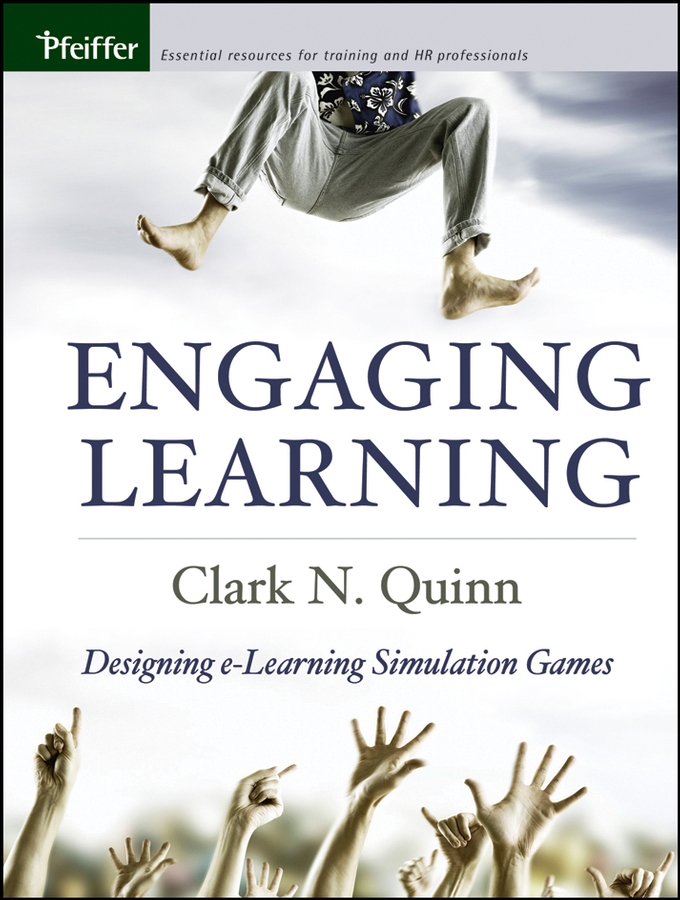
Book coverSomeone asked me what I would say about my first book, Engaging Learning. And, coincidentally, my client just gave some copies to their client as part of our engagement, so I guess there’s still value in it!  And while I recognize it’s now about 13 years old, I really do believe it has relevance. Since they asked…

I saw the connections between computers and learning as an undergraduate, and designed my own major. My first job out of college was designing and programming educational computer games. Long story short: I went back for a Ph.D. in what was effectively ‘applied cognitive science’, but games continued to play a role in my career. And I reflected on it, and ultimately what started as a research agenda manifested as a model for explaining why games work and how to do it. And then when I started consulting, Pfeiffer asked me to write the book.

To be clear, I believe engagement matters.  We learn better when our hearts and our minds are engaged. (That’s the intent of the double meaning of the title, after all.)  Learning sticks when we’re motivated and in a ‘safe’ learning situation.  Learning can, and should, be ‘hard fun’.  However,  if we can’t do it reliably and repeatedly, it’s just a dream. I believe that if we systematically apply the principles in the book, we can do it (systematic creativity is  not an oxymoron ;).

One of the concerns was that things were changing fast even then (Flash was still very much in play, for example ;).  How to write something that wouldn’t be outdated even before it came out?  So I tied it to cognitive principles, as our brains aren’t changing that fast.  Thus, I think the principles in it still hold.  I’ve continued to check and haven’t found anything that undermines the original alignment that underpins designing engaging experiences.

And the book was designed for use. While the first three chapters set the stage, the middle three dig into details. There you’ll find the core framework, examples, and a design process. The design process was focused mostly on adding to what you already do, so as not to be redundant. The final three chapters wrap up pragmatics and future directions.

While ostensibly (and realistically) about designing games, it was really about engagement. For instance, the principles included were applied backwards to branching scenarios, and what I called linear and mini-scenarios. The latter just being better written multiple choice questions!

The book couldn’t cover everything, and I’ve expanded on my thinking since then, but I believe the core is still there: the alignment and the design process in particular. There have been newer books since then by others (I haven’t stayed tied to just games, my mind wanders more broadly ;) and by me, but as with my other books I think the focus on the cognitive principles gives lasting guidance that still seems to be relevant. At a recent event, someone told me that while I viewed mobile as a known, for others it wasn’t. I reckon that may be true for games and engagement as well. If we’re making progress, I’m pleased. So, please, start engaging learning by making engaging learning!

PS, I wrote a Litmos blog post about why engagement matters, as a prelude to a session I’ll be giving at their Litmos Live  online event (Nov 7-8) where I talk about how to do it.


Constraints on activities

23 October 2018 by Clark 2 Comments

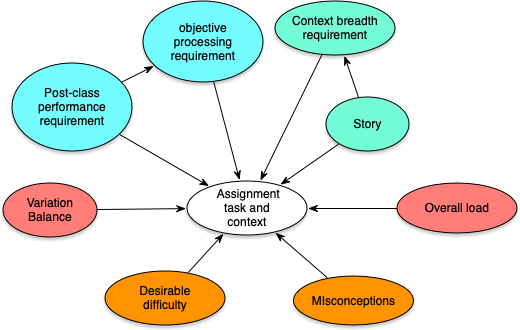
When we design learning activities (per the activity-based learning model), ideally we’re looking to create an integration of a number of constraints around that assignment. I was looking to enumerate them, and (of course) I tried diagramming it.  Thought I’d share the first draft, and I welcome feedback!

Multiple constraints on assignmentsThe goal is an assignment that includes the right type of processing. This must align with what they need to be able to do after the learning experience. Whether at work or in a subsequent class. Of course, that’s factored into the objective for this learning activity (which is part of an overall sequence of learning).

Another constraint is making sure the setting is a context that helps establish the breadth of transfer. The choice should be sufficiently different from contexts seen in examples and other practices to facilitate abstracting the essential elements. And, of course, it’s ideally in the form of a story that the learner’s actions are contributing to (read: resolve). The right level of exaggeration could play an (unrepresented) role in that story.

We also need the challenge in the activity to be in the right range of difficulty for the learner. This is the integration of flow and learning to create meaningful engagement.  And we want to include ways in which learners typically go wrong (read: misconceptions). Learners need to be able to make the mistakes here so we’re trapping and addressing them in the learning situation, not when it could matter.

Finally, we want to make sure there’s enough variation across tasks. While some similarities benefit for both consistency and addressing the objective, variety can maintain interest. We need to strike that balance. Similarly, look at the overall workload: how much are we expecting, and is that appropriate given the other constraints outside this learning goal.

I think you can see that successfully integrating these is non-trivial, and I haven’t even gotten into how to evaluate this, particularly to make it a part of an overall assessment. Yet, we know that multiple constraints help make the design easier (at least until you constrain yourself to an empty solution set ;).  This is probably still a mix of art and science, but by being explicit you’re less likely to miss an element.

We want to align activities with the desired outcome, in the full context.  So, what am I missing?  Does this make sense?


Labels, models, and drives

16 October 2018 by Clark Leave a Comment

In my post last week on engagement, I presented the alignment model from my  Engaging Learning  book on designing learning experiences. And as I thought about the post, I pondered several related things about labels, models, and drives. I thought I’d wrestle with them ‘out loud’ here, and troll (in the old sense) to see what you think.

Some folks have branded a model and lived on that for their career. And, in a number of cases, that’s not bad: they’re useful models and their applicability hasn’t diminished. And while, for instance, I think that alignment model is as useful as most models I’ve seen, I didn’t see any reason to tie my legacy to it, because the principles I like to comprehend and then apply to create solutions aren’t limited to just engagement. Though I wonder if people would find it easier to put the model in practice if it had a label.  The Quinn Engagement model or somesuch?

I’ve also created models around mobile, and about performance ecosystems, and more. I can’t say that they’re all original (e.g. the 4Cs of mobile), though I think they have utility. And some have labels (again, the 4Cs, Least Assistance Principle…) Then the misconceptions book is very useful, but the coverage there isn’t really mine, either. It’s just a useful compendium. I expect to keep creating models. But it’d led to another thought…

I’ve seen people driven to build companies. They just keep doing it, even if they’ve built one and sold it, they’re always on it; they’re serial entrepreneurs. I, for instance, have no desire to do that. There are elements to that that aren’t me.    Other folks are driven to do research: they have a knack for designing experiments that tease out the questions that drive them to find answers. And I’ve been good at that, but it’s not what makes my heart beat faster. I do  like action research, which is about doing with theory, and reflecting back. (I also like helping others become able to do this.)

What I’m about is understanding and applying cognitive science (in the broad sense) to help people do important things in ways that are enabled by new technologies.  Models that explain disparate domains are a hobby. I like finding ways to apply them to solve new problems in ways that are insightful but also pragmatic.   If I create models along the way (and I do), that’s a bonus. Maybe I should try to create a model about applying models or somesuch. But really, I like what I do.

The question I had though, is whether anyone’s categorized ‘drives’.  Some folks are clearly driven by money, some by physical challenges. Is there a characterization?  Not that there needs to be, but the above chain of thought led me to be curious. Is there a typology of drives? And, of course, I’m skeptical if there is one (or more), owing to the problems with, for instance, personality types and learning styles :D. Still, welcome any pointers.

Where’s Clark? Fall 2018/Spring 2019 Events Schedule

2 October 2018 by Clark Leave a Comment

Here’re the events where I’ll be through the last quarter of this year, and into the next. Of course, you can always find out what’s up at the Quinnovation News page… But this is a more likely place for you to start unless you’re looking to talk to me about work.  I hope to see you, virtually or in person, at one of these!

The week of October 22-26, Clark will be speaking (the same week!) at DevLearn on measurement and eLearning science, and at AECT on meta-learning architecture. (Yeah, both in one week…long story.)

On Litmos’ Live Virtual Summit on 7-8 November, Clark will talk Learning Experience. Stay tuned!

Clark will be a guest on Relate’s eLearnChat on 15 Nov.

2019

On the 9th of January, Clark will present The Myths that Plague Us as a webinar for HRDQ-U.

Clark will be presenting in the Modern Workplace Learning track at the LearnTec conference in Karlsruhe, Germany that runs 29-31 January.

Feb 25-27, Clark will serve as host of the Strategy Track at Training Magazine’s annual conference, opening with an overview and closing with a strategy-development session.

Clark will speak to the Charlotte Chapter of ISPI on the Performance Ecosystem on March 14.

At the eLearning Guild’s Learning Solutions conference March 25-28, Clark will be presenting a Learning Experience Design workshop, where we’ll go deep on integrating learning science and engagement.

If you’re at one of these events, please do introduce yourself and say hello (I’m not aloof, I’m just shy; er, ok, at least ’til we get to know one another :).

ONE level of exaggeration

26 September 2018 by Clark 5 Comments

I’ve argued before that we should be thinking about exaggeration in our learning design. And I’ve noticed that it’s a dramatic trick in popular media. But you can easily think of ways it can go wrong. So what would be appropriate exaggeration?

When I look at movies and other story-telling media (comics), the exaggeration  usually is one level.  You know, it’s like real life but some aspect is taken beyond what’s typical. So, more extreme events happen: the whacky neighbor is  maniacal, or the money problems are  potentially fatal, or the unlikely events on a trip are just more extreme.  And this works; real life is mundane, but you go too far and it treads past the line of believability. So there’s a fine line there.

Now, when we’re actually performing, whether with customers or developing a solution, it matters. It’s our  job after all, and people are counting on us.  There’s plenty of stress, because there are probably not enough time, and too much work, and…

However, in the learning situation, you’re just mimicking the real world. It’s hard to mimic the stress that comes from real life. So, I’m arguing, we should be bringing in the extra pressure through the story. Exaggerate!  You’re not just helping a customer, you’re helping the foreign ambassador’s daughter, and international relations are at stake!  Or the person you’re sweet on (or the father of said person) is watching!  This is the chance to have fun and be creative!

Now, you can’t exaggerate everything. You could add extraneous cognitive load in terms of processing if you make it too complex in the details. And you definitely don’t want to change the inherent decisions in the task and decrease the relevance of the learning. To me, it’s about increasing the meaning of the decisions, without affecting their nature. Which may require a bit of interpretation, but I think it’s manageable.

At core, I don’t think I’m exaggerating when I say exaggeration is one of your tools to enhance engagement  and effectiveness. The closer we bring the learning situation to the performance situation, the higher the transfer. And if we increase the meaningfulness of the learning context to match the performance context, even if the details are more dissimilar, I think it’s an effective tradeoff. What do  you think?

Mobile Malarkey

1 August 2018 by Clark 1 Comment

I was called out on a tweet pointing to an article on mobile. And, I have to say, I thought it was pretty underwhelming. It was the ‘old school’ view of mlearning, and I think that the post largely missed the point. So I thought it’d be valuable to walk through the claims. What I’m trying to accomplish is share how my thinking works, and perhaps contaminate you with a wee bit of it too ;). We need to get better at cutting through the hype (part of the debunking skills), and that includes microlearning and mobile malarkey as well.

The post makes four claims for why mobile is on the rise:

  • the advancements in mobile technology
  • the desire for small content
  • more engaging content
  • consumption ‘on the go’

So let’s go through these.  However, first I’m going to challenge the assumption!

Mobile is not ‘on the rise’.  That’s so 2012.  Mobile is well past the ‘new’ stage.  Heck, Google was arguing ‘mobile first’ back in 2010!  Even here in the US, it’s mainstream, and it’s been the ‘goto’ mode in other countries for much longer.

Now, the advancements in mobile technology  are continuing, and impressive.  Things like sensors for contextual information, networking for social connections, new interaction capabilities like pressure-sensitivity, and higher resolution screens and faster processors mean new capabilities.  What the article is talking about, is cutting edge content. Yes, video can be useful ‘on demand’, and interactivity can be powerful.  In context.  But they’re not picking up on that. This is still the ‘get training wherever you are’ mentality.  Mobile is really not about courses!  But maybe they’ll get better..

Next is the chunks. Ok, so I’ve already weighed in on ‘microlearning’.  Yes, small is better. It  does matter whether you’re talking performance support or spaced learning, but small is good. However, this article touts that we prefer smaller chunks (er, yes, and that’s not a good indicator).  And that we benefit from smaller. Yes, but this is still about ‘content consumption’.  Mobile can, and should be more than that.

On to engagement. Here the claim is that these small bits are more engaging, but that we can do interactive things as well. And this is good: mini-scenarios (better written multiple choice), even branching scenarios can lead to better. However, here they’re talking quizzes and infographics. Again, mostly content, and also focused on knowledge, not skills. This isn’t where the emphasis should be. Spaced learning yes, but reactivation – reconceptualization, recontextualization, and reapplication – not content dump and knowledge test.

Finally, it’s about remote workers. Yes, again, contextualization to give the right thing, to the right person, at the right time and place. But no, they’re talking about accessing training where/when/ever. Yes, that’s nice.  But not intrinsically exciting, and definitely not really capitalizing on mobile’s promise.

Look, the real mobile opportunity is about performance support and contextualized learning. Spaced learning is good (though not unique to mobile).  But to argue mobile’s on the rise, and it’s about content, is to misconstrue the state of the industry  and the opportunity. This is obviously a sales pitch for their mobile content delivery, but get clear about what you want from mobile. It’s a platform, so once you start people will expect more. It’s best if you need to think strategically about all that you can do and ensure you’ve seen the full picture before you settle on any one solution.

« Previous Page
Next Page »

Clark Quinn

The Company

Search

Feedblitz (email) signup

Never miss a post
Your email address:*
Please wait...
Please enter all required fields Click to hide
Correct invalid entries Click to hide

Pages

  • About Learnlets and Quinnovation

The Serious eLearning Manifesto

Manifesto badge

Categories

  • design
  • games
  • meta-learning
  • mindmap
  • mobile
  • social
  • strategy
  • technology
  • Uncategorized
  • virtual worlds

License

Previous Posts

  • September 2026
  • August 2026
  • July 2026
  • June 2026
  • May 2026
  • April 2026
  • March 2026
  • February 2026
  • January 2026
  • December 2025
  • November 2025
  • October 2025
  • September 2025
  • August 2025
  • July 2025
  • June 2025
  • May 2025
  • April 2025
  • March 2025
  • February 2025
  • January 2025
  • December 2024
  • November 2024
  • October 2024
  • September 2024
  • August 2024
  • July 2024
  • June 2024
  • May 2024
  • April 2024
  • March 2024
  • February 2024
  • January 2024
  • December 2023
  • November 2023
  • October 2023
  • September 2023
  • August 2023
  • July 2023
  • June 2023
  • May 2023
  • April 2023
  • March 2023
  • February 2023
  • January 2023
  • December 2022
  • November 2022
  • October 2022
  • September 2022
  • August 2022
  • July 2022
  • June 2022
  • May 2022
  • April 2022
  • March 2022
  • February 2022
  • January 2022
  • December 2021
  • November 2021
  • October 2021
  • September 2021
  • August 2021
  • July 2021
  • June 2021
  • May 2021
  • April 2021
  • March 2021
  • February 2021
  • January 2021
  • December 2020
  • November 2020
  • October 2020
  • September 2020
  • August 2020
  • July 2020
  • June 2020
  • May 2020
  • April 2020
  • March 2020
  • February 2020
  • January 2020
  • December 2019
  • November 2019
  • October 2019
  • September 2019
  • August 2019
  • July 2019
  • June 2019
  • May 2019
  • April 2019
  • March 2019
  • February 2019
  • January 2019
  • December 2018
  • November 2018
  • October 2018
  • September 2018
  • August 2018
  • July 2018
  • June 2018
  • May 2018
  • April 2018
  • March 2018
  • February 2018
  • January 2018
  • December 2017
  • November 2017
  • October 2017
  • September 2017
  • August 2017
  • July 2017
  • June 2017
  • May 2017
  • April 2017
  • March 2017
  • February 2017
  • January 2017
  • December 2016
  • November 2016
  • October 2016
  • September 2016
  • August 2016
  • July 2016
  • June 2016
  • May 2016
  • April 2016
  • March 2016
  • February 2016
  • January 2016
  • December 2015
  • November 2015
  • October 2015
  • September 2015
  • August 2015
  • July 2015
  • June 2015
  • May 2015
  • April 2015
  • March 2015
  • February 2015
  • January 2015
  • December 2014
  • November 2014
  • October 2014
  • September 2014
  • August 2014
  • July 2014
  • June 2014
  • May 2014
  • April 2014
  • March 2014
  • February 2014
  • January 2014
  • December 2013
  • November 2013
  • October 2013
  • September 2013
  • August 2013
  • July 2013
  • June 2013
  • May 2013
  • April 2013
  • March 2013
  • February 2013
  • January 2013
  • December 2012
  • November 2012
  • October 2012
  • September 2012
  • August 2012
  • July 2012
  • June 2012
  • May 2012
  • April 2012
  • March 2012
  • February 2012
  • January 2012
  • December 2011
  • November 2011
  • October 2011
  • September 2011
  • August 2011
  • July 2011
  • June 2011
  • May 2011
  • April 2011
  • March 2011
  • February 2011
  • January 2011
  • December 2010
  • November 2010
  • October 2010
  • September 2010
  • August 2010
  • July 2010
  • June 2010
  • May 2010
  • April 2010
  • March 2010
  • February 2010
  • January 2010
  • December 2009
  • November 2009
  • October 2009
  • September 2009
  • August 2009
  • July 2009
  • June 2009
  • May 2009
  • April 2009
  • March 2009
  • February 2009
  • January 2009
  • December 2008
  • November 2008
  • October 2008
  • September 2008
  • August 2008
  • July 2008
  • June 2008
  • May 2008
  • April 2008
  • March 2008
  • February 2008
  • January 2008
  • December 2007
  • November 2007
  • October 2007
  • September 2007
  • August 2007
  • July 2007
  • June 2007
  • May 2007
  • April 2007
  • March 2007
  • February 2007
  • January 2007
  • December 2006
  • November 2006
  • October 2006
  • September 2006
  • August 2006
  • July 2006
  • June 2006
  • May 2006
  • April 2006
  • March 2006
  • February 2006
  • January 2006

Amazon Affiliate

Required to announce that, as an Amazon Associate, I earn from qualifying purchases. Mostly book links. Full disclosure.

We use cookies to ensure that we give you the best experience on our website. If you continue to use this site we will assume that you are happy with it.